
CRM-tied deterministic win-loss analysis works by scoring every closed deal against fixed, versioned rules pulled straight from your Salesforce fields, so each score is auditable back to its source data. For revenue leaders, that means forecast numbers you can defend in the boardroom without hedging. Salesforce-native scoring research points the same way: transparent logic beats black-box prediction when the number has to survive scrutiny.
TL;DR:
- Deterministic scoring ensures repeatable and auditable win-loss analysis, with scores directly linked to specific CRM field data and fixed rule versions.
- Implementing governance practices like mandatory fields, version control, lineage tracking, and regular coverage targets significantly enhances forecast accuracy and auditability.
- Starting with rule-based Apex scoring is suitable for early governance levels, with ML or hybrid approaches introduced as data volume and quality improve.
- Improving forecast confidence relies more on governance, coverage, and consistency than on advanced algorithms, exemplified by coverage increases from 20-30% to over 85%.
- Combining quantitative scoring with qualitative insights from sales and customer interviews optimizes taxonomy, market understanding, and actionable decision-making.
Table of Contents
- What is CRM-tied, deterministic win-loss analysis?
- Why deterministic scoring improves forecast accuracy and board defence
- Core components: what your CRM and RevOps practice must have
- Rules, ML or hybrid: choosing your Salesforce architecture
- How do you measure and defend the commit number?
- How CommitControl maps to the deterministic checklist
- Where win-loss analysis programmes actually break down
- What actionable insights actually come out of this data?
- What do real improvements from win-loss review look like?
- How should you interview sales teams and customers for qualitative signal?
- What other tools support win-loss work beyond Salesforce?
- How does win-loss analysis fit your wider sales and marketing strategy?
- What should CROs prioritise first?
- Ready to see deterministic scoring on your own pipeline?
- Sources
What is CRM-tied, deterministic win-loss analysis?
This is not the buyer-interview programme most search results describe. That version asks “why did we lose the deal?” through customer conversations and surveys. This article is about something different: a CRM-driven method that scores closed opportunities using fixed rules against fields already sitting in Salesforce.
The inputs are mechanical: opportunity stage history, activity timestamps, engagement counts, deal age, competitor field entries, close reasons, and champion engagement scores. None of it requires a new conversation with the buyer.
Deterministic means the same inputs always produce the same score. Feed the rules engine identical opportunity data twice, and you get an identical result twice. That sounds obvious, but it is the entire point. A probabilistic model can shift its output as its weights retrain; a deterministic model cannot drift without someone changing the rule and logging the change. That property, not the sophistication of the maths, is what makes a score defendable in front of a board.
Why deterministic scoring improves forecast accuracy and board defence
Governed, rule-based scoring produces something ML models often cannot: a number nobody has to take on faith. Every score traces back to specific field values and a specific rule version, so a CRO can walk a board member through the reasoning line by line instead of saying “the model says so.”
The operational upside compounds from there. Deterministic rules eliminate the debate that eats up forecast calls, where two reps argue over whether a deal is really “commit” or “best case” based on gut feel. A fixed rule set removes that argument because the criteria are published and identical for everyone.
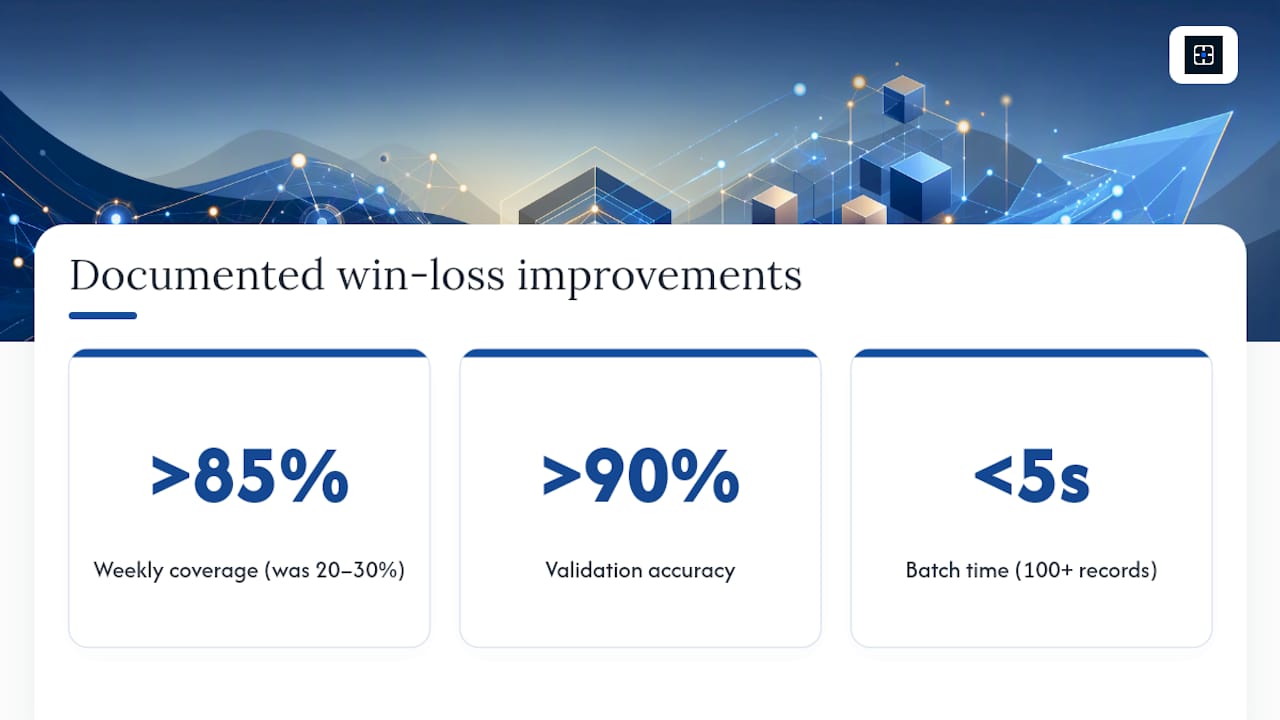
Coverage is where the gap becomes measurable. One reported operational case found weekly win-loss coverage rising from 20 to 30 percent up to more than 85 percent once teams automated ingestion and applied deterministic transformation rules instead of relying on manual review. That is the difference between a forecast built on a fifth of your pipeline and one built on nearly all of it.
Separately, a Salesforce-native automated risk classification system has demonstrated validation accuracy exceeding 90% with sub-5-second processing on batches of 100-plus records, evidence that deterministic and rule-driven approaches inside Salesforce can be both fast and reliable at production scale.
Core components: what your CRM and RevOps practice must have
Before any scoring logic runs, your Salesforce instance needs a foundation that will not buckle under audit. Skip this and every downstream score is only as trustworthy as the mess underneath it.
- Governed schema with mandatory closed-deal fields. Close reason, competitor, deal age, and loss category should be required, not optional, with validation rules that stop a rep from closing a deal without them.
- Preserved raw evidence alongside normalised fields. Keep call notes, transcript references, and free-text reasons intact, then map them into a controlled taxonomy so “lost to budget” and “no budget approved” collapse into one category rather than fragmenting your reporting.
- Versioned scoring logic. Every rule change gets a version number and a timestamp. When someone asks why a deal scored differently in March versus June, you point to the version log, not a shrug.
- Fixed reporting windows and a named owner. Weekly, not “whenever someone gets to it.” RevOps should own the cadence; sales leadership owns the action.
- Automated lineage linking each score to its source fields. If a score cannot be traced to the exact CRM values that produced it, it fails your audit standard before it reaches a forecast deck.
- Weekly coverage targets and quality gates. Set a minimum percentage of closed deals that must be scored each week, and block reporting if the gate is missed.
Guidance on building win-loss programmes consistently recommends structured capture on every closed deal, paired with a continuous cadence rather than sporadic reviews, because coverage gaps are where forecast confidence quietly leaks away.
Pro Tip: Run a monthly “reproducibility check” where someone recalculates five random deal scores by hand using the published rules. If they cannot reproduce the system’s output, your lineage has a gap, not your maths.
Rules, ML or hybrid: choosing your Salesforce architecture
Salesforce gives you three realistic paths, and the right one depends on data maturity, not ambition. A pattern demonstrated in recent Salesforce-native research shows autonomous Agentforce-style workflows executing multi-step actions, updating records, creating follow-up tasks, notifying managers, without a human trigger, all while keeping a full audit trail through Apex logic.
- Rule-based (Apex) scoring suits organisations early in their governance journey. It deploys fast, every score is explainable in one sentence, and it plateaus at roughly 60 to 70% predictive accuracy, which is often enough for commit-gating purposes where explainability matters more than marginal precision.
- Machine learning models become worthwhile once you have sufficient historical volume and clean labelled outcomes. Developer analysis puts ML accuracy in the 75 to 85% range under those conditions, but the trade-off is reduced transparency.
- Hybrid architectures let ML surface patterns across thousands of deals while deterministic rules retain control of the commit gate itself. The complementary logic here mirrors a broader principle in go-to-market technology: treat probabilistic systems as signal generators and deterministic systems as the execution and audit layer, never the reverse.
The pragmatic sequence, backed by community guidance on opportunity management, is to start with rules to build data hygiene, then graduate to ML or hybrid scoring once volume and label quality genuinely support it.
How do you measure and defend the commit number?
Five metrics tell you whether your win-loss process is actually working, not just running:
- Forecast accuracy, measured as committed pipeline versus closed-won, tracked over rolling quarters.
- Locked commit rate, the percentage of “commit” category deals that close as forecast.
- Weekly coverage percentage, the share of closed deals scored within your fixed reporting window.
- Variance by rep and segment, which surfaces whether scoring drift is systemic or localised to one team.
- Distribution of loss reasons, tracked over time to spot shifting competitive pressure or pricing objections.
Audit mechanics matter as much as the metrics themselves. Every rule version needs a timestamp, every score needs a lineage drilldown back to source fields, and a sample of scored deals should carry attached evidence, call notes, email threads, that a board member could request and receive within minutes.
A board-ready commit statement follows a simple template: state the number, name the rule version that produced it, attach three to five sample deal receipts, and state the expected error margin based on historical variance. That last part matters more than most CROs assume: a number with no stated margin of error reads as either naive or evasive.
How CommitControl maps to the deterministic checklist
Some deterministic scoring platforms build their scoring model around the checklist above, not as an add-on but as the core architecture. Every score runs on deterministic, versioned rules, so the same opportunity data always produces the same result, and every rule change is logged with a version stamp rather than silently overwritten.
Evidence lineage runs from the score straight back to the CRM fields that produced it. When a VP of Sales asks why a deal scored as “at risk,” the answer is a specific field value, not a probability the system cannot fully explain. Data governance and taxonomy control sit underneath that, keeping loss reasons, competitor fields, and deal stages consistent across the whole pipeline rather than fragmenting by rep habit.
The practical output can be an auditable forecast-defence report. Walking into a board meeting, a customer can bring the score lineage, the rule logic snapshot active at the time, and sample deal receipts, the same three artefacts described in the commit template above, built directly from what such platforms track.
Where win-loss analysis programmes actually break down
Most win-loss efforts fail quietly, not dramatically. The most common failure is inconsistent field completion: reps close deals fast at quarter-end and skip the loss-reason dropdown, leaving RevOps with a taxonomy full of “Other.”
A second pitfall is rule sprawl without version control. Someone tweaks a scoring threshold to fix one edge case, forgets to document it, and three months later nobody can explain why April’s scores differ from January’s on identical inputs. That is not a technology failure; it is a governance failure, and it is entirely avoidable with a simple version log.
Sampling bias creates a third problem, particularly where teams blend automated scoring with manual review. If only the largest or most contentious deals get manually reviewed, the resulting insights skew toward enterprise edge cases and miss the mid-market pattern actually driving most of the pipeline.
A fourth, subtler pitfall: treating the taxonomy as static. Competitive landscapes shift, pricing objections evolve, and a loss-reason list built two years ago stops capturing what is actually happening in the market. Review the taxonomy on a fixed schedule, not just when someone complains it feels stale.
Finally, plenty of programmes collapse under their own reporting cadence. A monthly review sounds reasonable until a CRO needs a mid-quarter answer and the last scored data is five weeks old. Weekly coverage targets, mentioned earlier as a core component, exist specifically to prevent this gap.
What actionable insights actually come out of this data?
The value of CRM-tied scoring shows up in the specific decisions it enables, not the dashboards it produces. A distribution of loss reasons that shifts from “pricing” to “missing feature” over two consecutive quarters tells product and sales leadership something concrete: the competitive gap has moved from commercial to functional, and pricing concessions will not fix it.
Variance by segment often reveals uneven rep performance that a single win rate number hides. If enterprise deals score consistently lower on engagement-count fields before closing lost, that points to a specific coaching gap, not a market problem.
Deal-age scoring against close reason frequently exposes stalled opportunities that reps have quietly stopped working but never formally closed. Surfacing those as “aged, low engagement, high loss probability” lets a sales manager intervene before the deal sits in the pipeline distorting coverage for another quarter.
Competitor field data, tracked deterministically across every closed deal, builds a genuine competitive analysis over time rather than a handful of anecdotes from account executives. If one named competitor appears in 40% of losses in a single vertical, that is a strategic signal for both sales enablement and product positioning, not a talking point for one deal review.
None of these insights require a new interview program. They come from disciplined use of fields your Salesforce instance likely already contains, scored consistently and reviewed on a fixed cadence rather than left to accumulate.
What do real improvements from win-loss review look like?
The clearest documented gains come from coverage, not sophistication. One reported operational deployment moved weekly win-loss coverage from a range of 20 to 30 percent up to over 85 percent purely by automating ingestion and applying deterministic transformation rules instead of manual, ad hoc review.
That kind of jump changes what a forecast call actually means. A commit number built on 25% of closed deals is essentially a guess dressed up as analysis.
On the technical implementation side, a Salesforce-native automated risk classification build has been documented achieving validation accuracy above 90% alongside sub-5-second batch processing across 100-plus records and full test-case pass rates. That result matters less for the accuracy figure alone and more for what it proves: deterministic, rule-driven scoring built natively in Apex can run at production speed without sacrificing auditability.
The pattern across both cases is the same. Improvement did not come from a smarter algorithm chasing marginal accuracy gains. It came from governance, coverage, and consistency, the unglamorous plumbing that makes a scoring system trustworthy enough to build a forecast on.
How should you interview sales teams and customers for qualitative signal?
Deterministic scoring handles the mechanical layer, but the taxonomy behind it still needs human judgement to stay accurate, and that means structured input from your own sales team as well as selective customer conversations.
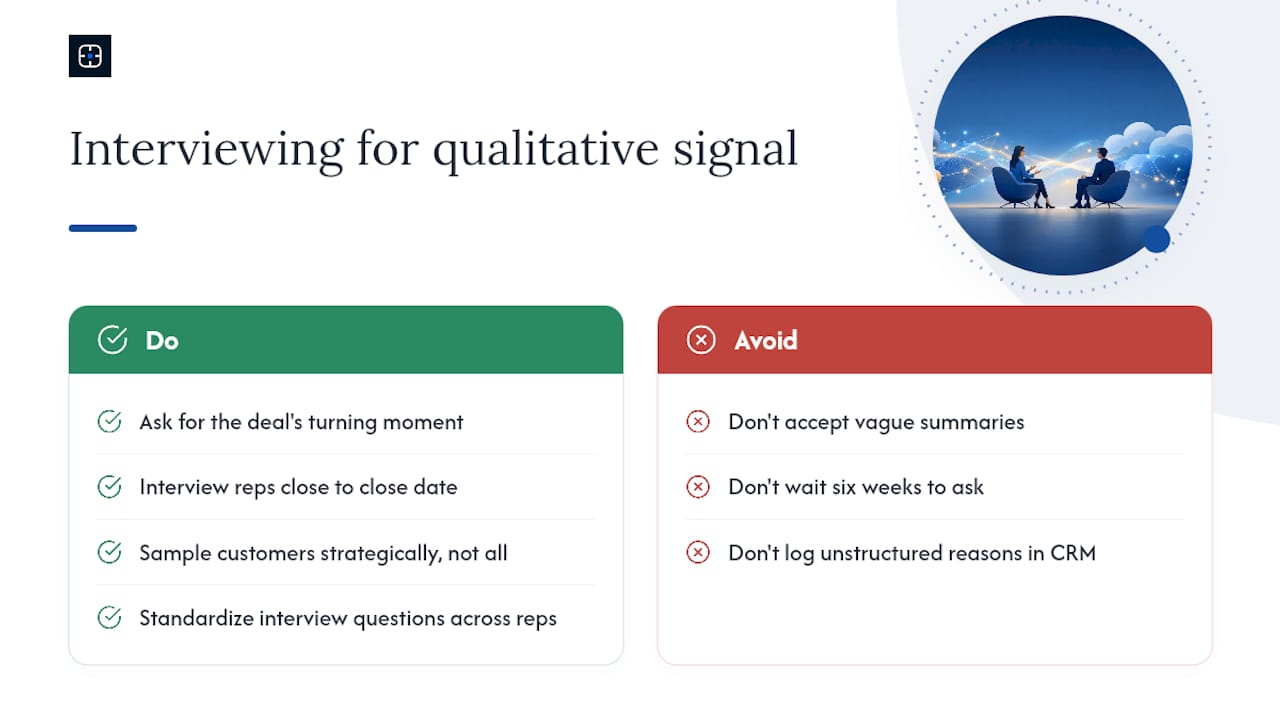
When interviewing reps about a lost deal, ask for the specific moment the deal turned, not a general summary. “The prospect went quiet after the pricing call” is usable data; “it just didn’t work out” is not, and it will corrupt your loss-reason taxonomy if logged as-is.
Keep interviews close to the close date. Memory degrades fast, and a rep asked about a loss six weeks later will reconstruct a plausible story rather than recall the actual sequence of objections.
For customer-facing validation, sample strategically rather than universally. Guidance on building win-loss programmes recommends structured capture on every deal, paired with buyer interviews on a strategic sample, because interviewing every lost customer is neither feasible nor necessary; a well-chosen sample validates whether your automated taxonomy still matches reality.
Standardise the interview questions across every rep and every reviewer. If one manager asks about pricing and another asks about competitive fit, you cannot compare answers across the pipeline, which defeats the purpose of building a consistent taxonomy in the first place.
Feed what you learn straight back into the taxonomy governance layer. A qualitative finding that surfaces three times in interviews but has no corresponding CRM field is a signal your schema needs a new mandatory field, not just a note in a spreadsheet.
What other tools support win-loss work beyond Salesforce?
Salesforce holds the system of record, but several categories of tooling extend what you can do with the same underlying data. Conversation intelligence platforms capture call transcripts and surface objection language automatically, feeding structured signal into your CRM fields rather than relying on reps to summarise accurately after the fact.
Business intelligence layers sitting on top of Salesforce, whether native reporting or a dedicated analytics tool, turn scored deal data into the trend views a board actually wants to see: loss reason distribution over time, variance by segment, coverage percentage trending week over week.
Survey tools remain useful for the buyer-interview side of a broader revenue programme, though that qualitative research track sits outside the deterministic, CRM-tied scoring this article covers. Keep the two tracks separate in your reporting; conflating survey sentiment with deterministic deal scores muddies both.
Deterministic scoring platforms built specifically for Salesforce, CommitControl among them, sit closest to the core workflow described throughout this piece: rules run against CRM fields, scores generate automatically, and lineage stays intact without requiring a parallel data pipeline outside your existing system of record. For most B2B sales organisations already committed to Salesforce, the fewer systems touching the same deal data, the fewer places auditability can break.
How does win-loss analysis fit your wider sales and marketing strategy?
Win-loss scoring loses most of its value if it stays locked inside RevOps reporting and never reaches the teams who can act on it. Loss reason distribution belongs in the same room as product roadmap planning; if “missing integration” appears repeatedly across lost enterprise deals, that is a roadmap input, not just a sales statistic.
Marketing needs the competitive field data too. If a named competitor shows up disproportionately in losses within a specific vertical, that shapes messaging and campaign targeting far more precisely than generic market research.
Sales enablement should treat variance-by-rep data as a coaching curriculum, not a performance scorecard to hide. A rep whose deals consistently score poorly on engagement-count fields before losing needs a specific intervention, more discovery calls, better champion identification, not a vague note to “improve closing skills.”
The alignment mechanism itself should be as disciplined as the scoring: a fixed monthly cross-functional review where RevOps presents the scored data, and product, marketing, and enablement leaders each commit to one action based on what the taxonomy revealed that month. Without that structured handoff, even a perfectly governed scoring system just produces reports nobody reads.
What should CROs prioritise first?
Governance beats sophistication, every time I have seen this play out. The instinct in most revenue organisations is to reach for a machine learning model because it sounds more advanced, but a hybrid or ML layer built on top of ungoverned data just produces confident-sounding noise faster than a spreadsheet did.
Prioritise in this order: deterministic governance first, so every score is versioned and traceable. Data hygiene second, because no scoring logic survives contact with inconsistent loss-reason fields. Selective ML only once those two are genuinely solid, and only where the data volume actually supports it.
A rough 30/60/90 plan: in the first 30 days, audit your current closed-deal fields and mandate the ones that are missing. By day 60, get one fixed scoring rule set live with version control and weekly coverage reporting. By day 90, run your first board-ready commit package with full lineage attached and measure whether the forecast variance actually narrowed.
— Brian
Ready to see deterministic scoring on your own pipeline?
Everything in the checklist above, versioned rules, evidence lineage, taxonomy governance, auditable commit reports, is what some deterministic scoring platforms run on by default rather than as a configuration project. If you have read this far because your last board meeting ended with someone asking “how confident are we in this number, really?”, that is precisely the gap deterministic scoring closes.
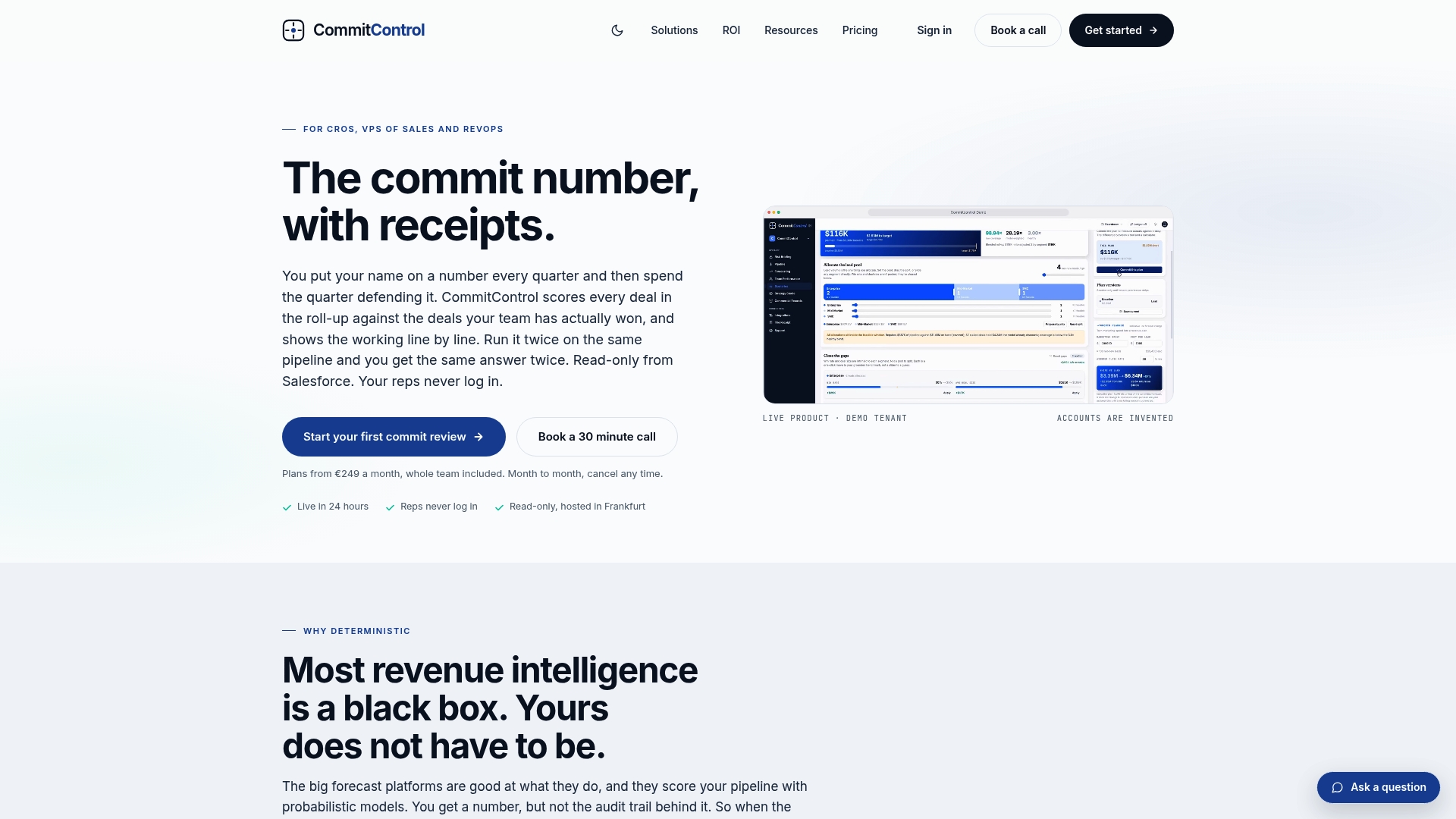
Start by quantifying what an inaccurate forecast is actually costing you: the Sales Forecast Miss ROI Calculator turns forecast variance into a concrete figure worth taking to the CFO. If your organisation is mid-transition between sales leaders, the sales leadership transition guidance walks through resetting a credible forecast baseline from day one. When you are ready to see deterministic scoring against your own Salesforce data, book a walkthrough of CommitControl and bring your last quarter’s disputed deals; that is usually the fastest way to see the lineage in action.
Sources
- Intelligent Opportunity Risk Analysis and Win Prediction System Using Machine Learning on Salesforce Platform
- AI in Opportunity Management: Rule‑Based vs. Machine Learning Approaches - DEV Community
- Win/loss intelligence needs repeatable data controls, not manual review
- Deterministic vs. Probabilistic Systems in B2B Go-to-Market
Recommended
Created with BabyLoveGrowth to grow search traffic
See the same discipline applied to your pipeline.
CommitControl derives every figure from your own Salesforce data. Nothing is invented, and every number traces back to the record it came from. Connect Salesforce and the same view runs live on your data within 24 hours.
Evaluate CommitControl