Einstein Opportunity Scoring will help you triage pipeline if your organisation has enough clean, closed history to train it. It will not, on its own, defend a board forecast. Run a data readiness check first: count closed won and lost deals over the last 12 to 18 months. If you have fewer than a few hundred with balanced outcomes, or your forecast needs to survive audit scrutiny, look at a deterministic layer such as Commitcontrol alongside it.
TL;DR:
- Einstein Opportunity Scoring requires at least a few hundred balanced closed deals over 12 to 18 months to produce reliable, non-optimistic scores.
- It updates daily and retrains roughly every 10 days, meaning scores are dynamic and reflect recent data changes rather than static predictions.
- For accurate forecast defense, a deterministic scoring layer like Commitcontrol, which tracks exact field inputs, is essential, especially for audit or board scrutiny.
- Mismatches between scores and actual deal activity, such as Cold scores on committed deals or Hot deals in stagnation, should trigger targeted reviews and coaching conversations.
- Use Einstein scores mainly for pipeline triage and early detection of drift, but rely on traceable, rule-based scores for formal forecast justification and audit purposes.
Table of Contents
- What is Salesforce opportunity scoring?
- Do you have enough data to enable it?
- How do you turn on Einstein Opportunity Scoring?
- Where does the score earn its place in a forecast call?
- How do you stop the score from being gamed?
- Salesforce deal scoring for forecast defence: where deterministic scoring fits
- How do the underlying models actually learn?
- How does it compare to other scoring approaches?
- Where does deal scoring plug into the rest of your stack?
- What happens when teams put scores to work?
- How should you act on a score day to day?
- Salesforce deal scoring for forecast defence
- Ready to defend your next forecast number?
- Sources
- FAQ
What is Salesforce opportunity scoring?
Every quarter, a VP Sales stands before the board and reads out a number. The pipeline had a projected amount, but the quarter’s actual closure differed significantly, either exceeding or falling short of that projection. Nobody in the room can explain why the gap happened, because the forecast was built from reps’ gut feel and a stage field that gets updated the night before the pipeline review.
Salesforce built Einstein Opportunity Scoring to put a number on that gut feel. Every open opportunity gets a score from 1 to 99, and Salesforce groups that score into three tiers: hot, warm, and cold. Alongside the number sits a factors panel showing the top positive and negative signals driving it, things like deal age, stage duration, or contact engagement, pulled straight from Einstein Opportunity Scoring’s setup documentation.
Treat the score as a triage signal, not a verdict. It tells you where to look, not what to conclude. Two examples show the difference:
- A deal sits in “Commit” at £180,000 but drops to Cold overnight after a key contact goes quiet. That is a prompt to call the rep before the forecast call, not a reason to strike the deal automatically.
- A Warm deal jumps to Hot after three consecutive meetings get logged. That is grounds to ask whether it belongs in Best Case instead of sitting untouched in Pipeline.
Scores refresh daily, and the underlying model retrains on your organisation’s own closed data roughly every 10 days, according to Salesforce’s Sales Cloud Einstein datasheet. That cadence matters: a score you saw last Tuesday is not the score you will see today, and a sudden swing usually means something real changed in the record, not that the model is unstable.
Do you have enough data to enable it?
Einstein Opportunity Scoring needs a training baseline before it will produce anything usable. Salesforce requires a minimum volume of closed opportunities, split reasonably evenly between won and lost, or the data-readiness check blocks enablement outright, a limit confirmed in independent documentation on the feature’s training requirements. Balance matters as much as volume. An org with 500 closed deals but only 12 losses gives the model almost nothing to learn from on the losing side, and the scores it produces will lean optimistic.
Run three checks before you touch the setup screen:
- Count closed-won and closed-lost opportunities separately over the last 12 to 18 months, and check the split isn’t badly skewed.
- Audit activity capture: are calls, emails, and meetings actually logged against opportunities, or living in reps’ heads and inboxes?
- Check completeness on required fields, stage, close date, amount, so the model isn’t training on gaps.
The usual blockers are unglamorous. Too few historical deals, especially in a newer business unit or a recently split territory. Activity logging that only half the team bothers with. A heavy reliance on unstructured signals, tone of an email, body language on a call, that never made it into a Salesforce field in any form. Any of these leaves you with a score that is either unavailable or, worse, available and quietly wrong.
Pro Tip: Run the readiness audit as a spreadsheet export before you go anywhere near Setup. If the counts fail the threshold, you have just saved yourself a rollout that would have produced misleading scores your reps stop trusting within a month.
How do you turn on Einstein Opportunity Scoring?
Enablement is a short setup path, but the decisions you make around it matter more than the toggle itself.
- In Setup, search for Einstein Opportunity Scoring and switch it on for the relevant record types.
- Complete the data-readiness check Salesforce runs automatically. It will tell you if your history is too thin.
- Wait for first training, typically 24 to 48 hours, then confirm daily score updates are appearing on records.
- Add the Einstein Score and Top Factors component to your opportunity page layout and to relevant list views, so reps see it without hunting.
A handful of configuration decisions shape whether the score is trustworthy or noise. Exclude fields that leak the answer into the question, a free text “deal rationale” field that reps fill in with their own confidence level, or a field that duplicates your forecast category, will let the model cheat rather than learn. Salesforce’s own guidance flags this exclusion step directly. Set your hot, warm, and cold cutoffs deliberately rather than accepting defaults blindly, and decide up front whether score tiers feed into collaborative forecasting and dashboards or stay purely observational for now.
One retrain detail catches teams out: the model retrains roughly every 10 days, per the Sales Cloud Einstein datasheet. If you make a major schema change, a new mandatory field, a restructured stage set, right before a retrain cycle, expect a period where factor weightings shift and scores look unfamiliar until the model settles on the new shape of your data.
Where does the score earn its place in a forecast call?
This is where the feature either proves its worth or gets quietly ignored after month two. A score sitting unused on a record layout is decoration. A score cross-referenced against what reps are calling in commit is evidence.
Three checks belong in every pipeline review:
- Pull every deal marked Commit that carries a Cold score. That mismatch is the single highest-value flag in the whole exercise.
- Check Best Case deals scored Cold. These are usually the padding candidates that inflate a forecast without anyone admitting it.
- Find Hot-scored deals still sitting in open Pipeline, uncategorised. These are often under-called, and missing them costs you upside you already earned.
Build three dashboards to make this repeatable rather than a one-off audit:
- Pipeline value broken down by score tier, refreshed weekly.
- A cross-tab of rep-set commit category against Einstein tier, so mismatches surface automatically rather than requiring manual comparison.
- A stalled-deals report showing days in stage, which correlates closely with score decay.
When you find a mismatch, act on it rather than noting it and moving on. Request the missing next-action date or evidence field. Schedule a coaching conversation with the rep if the pattern repeats deal after deal. Downgrade the commit until the evidence improves. Force Management’s research on forecast inaccuracy backs this up directly: combining rep-set stage data with an independent, rule-based check is what actually catches suspicious deals, not either signal alone.
How do you stop the score from being gamed?
A score only stays useful if reps cannot quietly manipulate the inputs that feed it. That starts with verifiable exit criteria: a deal cannot advance a stage without a next action date and, if it closes lost, a recorded reason. Practical Salesforce deal-tracking guidance recommends exactly this, paired with validation rules that block stage hopping when required evidence fields are empty.
Governance also means deciding, in writing, who can exclude a field from the scoring model and logging every exclusion with a reason. Without that record, “we excluded the discount field” becomes an untraceable decision nobody can explain six months later when someone asks why the model behaves differently.
Watch for drift after every retrain. A 10 day cycle means your factor weightings can shift ten or twelve times a year, and a factor that mattered in Q1 might barely register by Q3 if your market or deal mix has changed.
Set a review rhythm and stick to it:
- Weekly: stalled-deals report, flagging anything sitting in stage past its typical duration.
- Monthly: model-effectiveness review, checking whether score tiers still correlate with actual close outcomes.
- Quarterly: data-quality remediation, cleaning up the gaps that accumulated since the last pass.
Pro Tip: Keep a simple change log for exclusions and cutoff adjustments, timestamped and attributed. When a board member asks why a deal scored differently than expected, “we changed the cutoff in March, here’s who approved it” beats a shrug every time.
Salesforce deal scoring for forecast defence: where deterministic scoring fits
Einstein Opportunity Scoring is a probabilistic model. Feed it the same deal twice and, across retrains, it can return a different number, because it learns and adjusts as your data changes. For pipeline triage, that adaptability is a genuine strength. For a board forecast that needs to be defended line by line six weeks after the fact, it is a liability: nobody can look at the number and say precisely why it was what it was.
Deterministic scoring, the approach Commitcontrol takes, works differently. The same inputs always produce the same score. Every signal traces back to a named Salesforce field, not a hidden weighting. A human, not the model, owns the final call on each deal.
Where does that matter most?
- Board presentations, where a director will ask “why is this deal a 62 and not a 71” and you need a real answer.
- Audit-sensitive revenue recognition, where a probabilistic score cannot substitute for a documented reasoning trail.
- Small but strategic deals, where one account carries disproportionate weight and a black-box number isn’t good enough.
| Job to be done | Einstein Opportunity Scoring | Deterministic scoring (Commitcontrol) |
|---|---|---|
| Daily pipeline triage | Strong fit | Adequate, less adaptive |
| Board forecast defence | Weak, hard to explain | Strong fit |
| Works with thin historical data | Blocked below threshold | Works from day one |
Commitcontrol’s product home and ROI calculator lay out how the reasoning trail behind each score gets built directly from your CRM data.
How do the underlying models actually learn?
Einstein Opportunity Scoring is not a fixed formula bolted onto Salesforce once and left alone. It trains on your organisation’s own closed opportunities, meaning two companies enabling the identical feature get meaningfully different scoring behaviour, because the deals that shaped the model differ.
That training process repeats. As noted earlier, the model retrains on recent closed data roughly every 10 days, folding in new wins, losses, and activity patterns as they accumulate. A deal that closed last week becomes part of the evidence base shaping how the next cohort of open opportunities gets scored.
This creates a genuine trade off. The model gets sharper as your pipeline matures and your closed-deal history grows, which is exactly why the data-readiness threshold exists in the first place: too little history and there is nothing meaningful to learn from. But it also means the model can drift. If your sales motion changes, a new product line, a shift to enterprise deals, a change in average sale size, the factors that mattered under the old pattern may lose relevance, and it takes several retrain cycles before the model catches up.

None of this is unique to Salesforce. Any learning system that trains on your own historical outcomes carries the same trade off: better fit to your business, less stability quarter to quarter. The practical response is not to distrust the model, but to build the governance habits already covered, exclusion logging, drift review, retrain monitoring, so shifts in scoring behaviour get noticed and explained rather than discovered by accident during a forecast call.
How does it compare to other scoring approaches?
Most vendors in the revenue intelligence category rely on black box models: opportunity data goes in, a probability comes out, and the reasoning in between stays proprietary. That is true of several well known enterprise forecasting platforms, and it is largely true of Einstein Opportunity Scoring itself. The trade off is real. Black box models can surface subtle patterns a rule based system would miss, particularly around engagement signals and deal velocity.
The cost of that opacity shows up at exactly the moment you need the score most: defending it. If a CFO asks why a £2 million deal scored 84 instead of 60, “the model weighted these factors” is a weaker answer than “here is the field, here is the rule, here is the person who owns this call.”
Rule based or deterministic approaches trade some of that pattern-finding subtlety for full traceability. Every input maps to a Salesforce field a reader can inspect directly. Nothing hides inside a retrained weighting nobody can reconstruct after the fact.
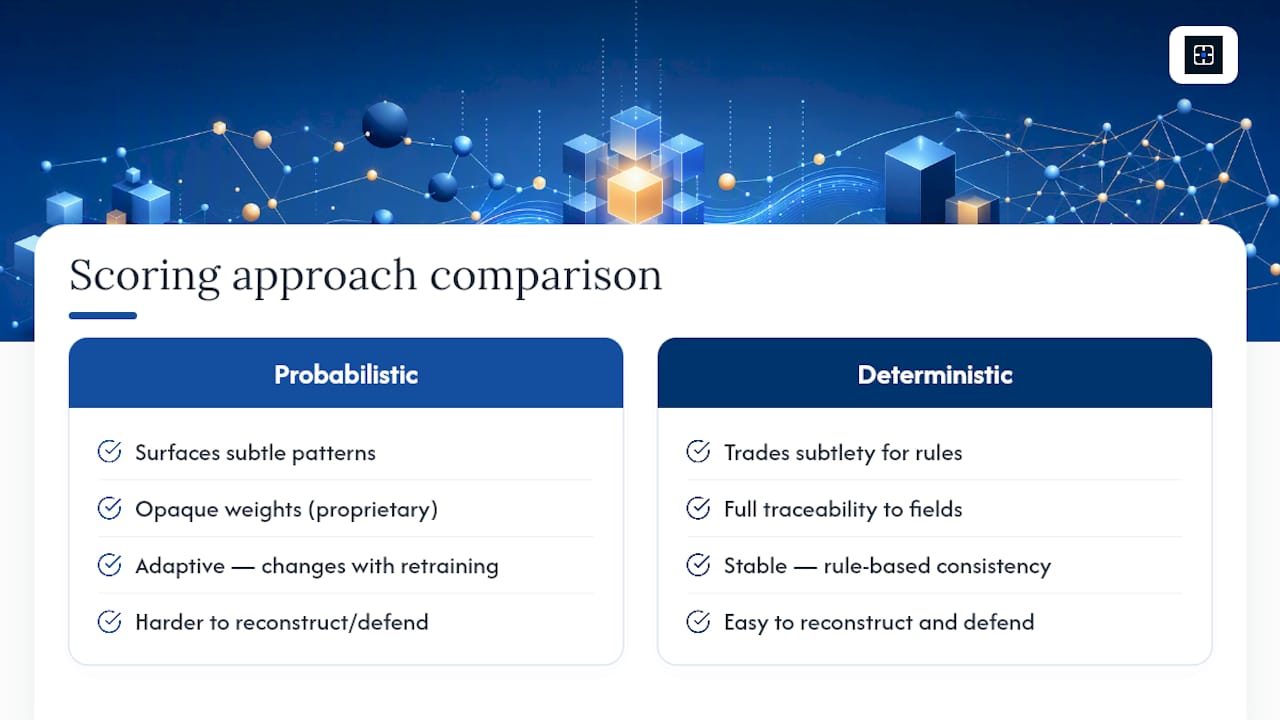
Neither approach is universally right. A fast growing SaaS business with thousands of deals and strong historical patterns will get real value from Einstein’s adaptive scoring for day to day triage. A mid market company preparing quarterly numbers for a board, or operating in a regulated sector where revenue recognition gets scrutinised, needs the second kind of evidence trail more than it needs a sharper prediction. Many organisations end up running both: Einstein for daily pipeline hygiene, a deterministic layer for the numbers that get defended in a room full of people who did not build the model.
Where does deal scoring plug into the rest of your stack?
A score is only as useful as the places it actually shows up. Einstein Opportunity Scoring surfaces natively on the opportunity record and in list views, but the real leverage comes from pushing it into the tools where decisions get made.
Collaborative Forecasting is the obvious first stop: once score tiers are visible alongside forecast categories, a sales manager reviewing the quarter can see rep-set commit sitting next to an independent signal without switching screens. Dashboards built on standard Salesforce reporting can slice pipeline by tier, by owner, by stage, using data that already lives in the org, no separate data warehouse required.
Beyond native Salesforce components, scoring data flows into whatever consumes CRM data more broadly: revenue dashboards in business intelligence tools, Slack or Teams alerts triggered by tier changes, or a deterministic layer such as Commitcontrol that reads the same opportunity fields and adds a traceable evidence layer on top. Because Einstein’s scoring lives inside standard and custom fields on the opportunity object, most integration paths are straightforward field level syncs rather than bespoke API work.
The practical implication for admins: treat the score as CRM data, not as a separate system to manage. Anywhere your organisation already pipes opportunity data, forecasting rollups, exec dashboards, quarterly business review decks, the score can go too, provided the field level permissions and page layout changes are made deliberately rather than left to default.
What happens when teams put scores to work?
The clearest business impact from deal scoring shows up not in the score itself but in what a review does with a mismatch. A pipeline review that finds three Commit deals carrying Cold scores has found three conversations worth having before the quarter closes, not three deals to strike automatically.
Without the score, that deal sails into the forecast unchallenged. With it, a manager has a specific, evidence-backed reason to ask for a next action date before accepting the call. Force Management’s analysis of forecast inaccuracy points to exactly this kind of independent cross-check as the mechanism that catches padding rep-set data alone would miss.
The inverse case matters just as much. A Hot-scored deal sitting untouched in open Pipeline, never called in Best Case or Commit, represents upside a forecast is quietly ignoring. Surfacing that mismatch in a dashboard turns an overlooked deal into a called number, which is as much a forecast accuracy win as catching an inflated one.
None of this requires a dramatic rebuild of the sales process. It requires the score to be visible in the room where the pipeline gets reviewed, and a manager willing to ask “why does this differ from what the score says” out loud, every time it does.
How should you act on a score day to day?
Treat every score change as a question, not an answer. A deal dropping from Warm to Cold is not a reason to write it off; it is a prompt to check what changed, a missed meeting, a stalled email thread, a competitor mention, and decide whether that change reflects reality or a data gap.
Build the habit into existing rhythms rather than creating a new one. In a weekly one to one, pull up any deal where score and rep confidence disagree and ask the rep to walk through it. In a monthly pipeline review, look at tier movement over the last four weeks rather than a single snapshot, since a deal drifting steadily downward tells a different story than one that dipped and recovered.
Resist the urge to let the score set strategy on its own. A Hot score on a small deal does not mean it deserves executive attention over a Warm score on a strategic account with a longer sales cycle. Scores describe likelihood based on patterns in your historical data; they do not know which accounts matter most to your business this quarter. Pair the score with account tier, deal size, and strategic weighting before deciding where reps and managers spend their time.
The teams that get the most out of scoring are the ones that use it to ask better questions faster, not the ones that use it to skip the conversation entirely.
Salesforce deal scoring for forecast defence
The conventional advice on deal scoring treats it as a solved problem: flip the switch, trust the number, move on. That advice undersells how much of the value comes from friction, not automation. A score that never gets questioned in a pipeline review is a wasted feature, no matter how well the underlying model performs.
What gets underestimated is how quickly reps learn to work around any single signal, score included, once they realise a manager isn’t cross-checking it against commit categories. The discipline of the weekly mismatch report matters more than the sophistication of the model producing the score.
Where I’d push back hardest on standard practice: treating Einstein’s score as sufficient evidence for a board forecast is a mistake, not because the model is bad, but because probabilistic and defensible are different jobs. A number that can shift after a retrain cycle, for reasons a board member cannot inspect, is not the same as a number built from fields anyone in the room can trace. Use Einstein for what it does well: daily triage, catching drift, prompting the right conversation early. Reach for a deterministic layer when the number has to survive being questioned line by line, in a boardroom, six weeks after the quarter closed.
— Brian
Ready to defend your next forecast number?
Every deterministic score produced traces back to specific fields already sitting in your Salesforce org. No hidden weightings, no retrain surprises the week before a board meeting, no rep workflow to relearn. Where Einstein Opportunity Scoring answers “how likely is this deal,” Commitcontrol answers “why is this deal a 62, and here is the evidence.”
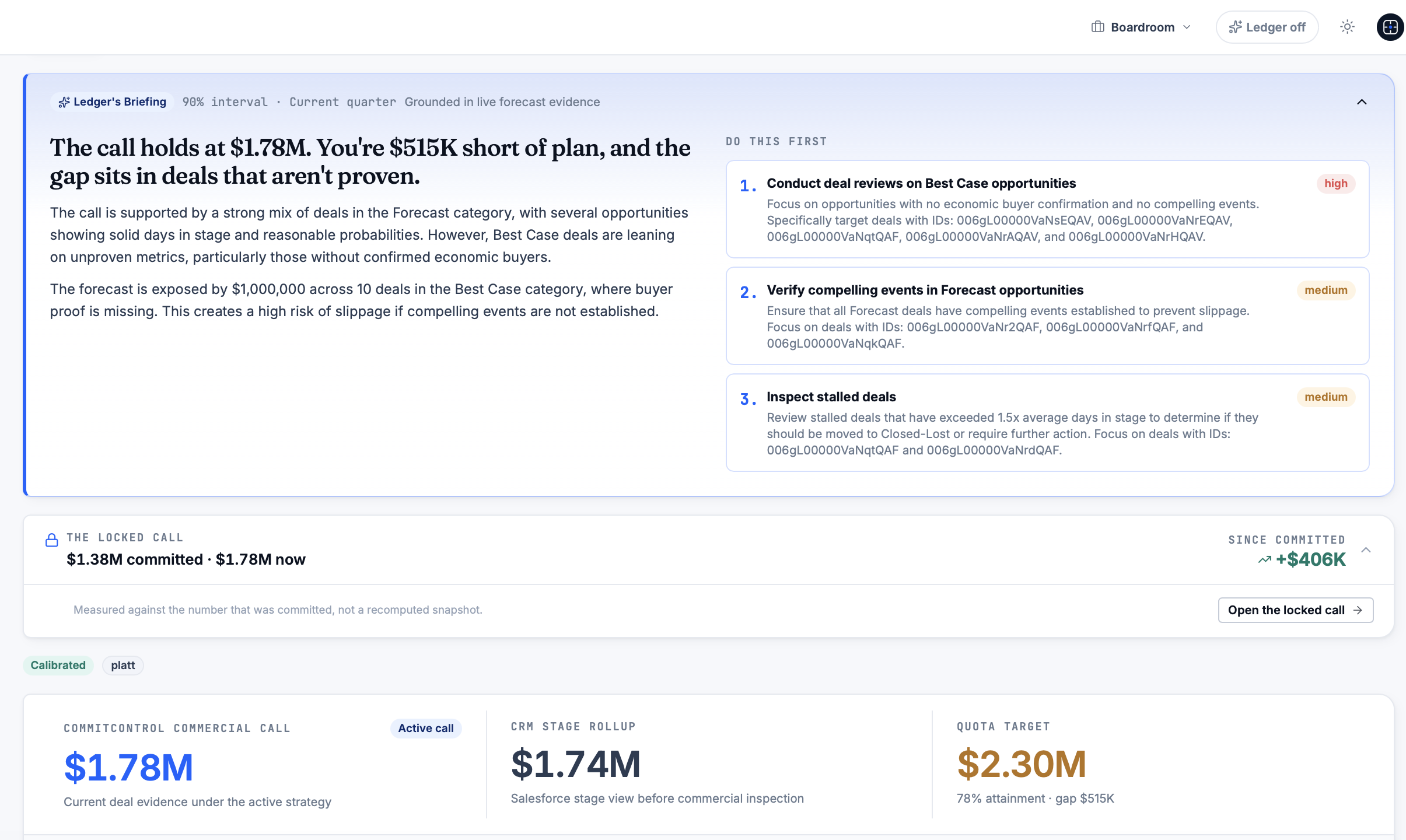
If forecast misses have cost you credibility with the board before, quantify what that actually costs using the Sales Forecast Miss ROI Calculator. If you’re mid-transition on your sales leadership team and rebuilding forecast trust from scratch, the sales leadership transition guide walks through how to reset the process without breaking rep workflow. Plans cover the whole team, not per seat pricing, and each score comes with a readable evidence trail tied directly to your CRM data. Book a demo through Commitcontrol and bring your last forecast miss to the call. We’ll show you what a deterministic score would have flagged before it happened.
Sources
- Forecast inaccuracy in B2B sales: causes and solutions — Force Management
- Enable Einstein Opportunity Scoring — Salesforce Help
- Sales Cloud Einstein datasheet — Salesforce
FAQ
How does lead scoring work in Salesforce?
Einstein Lead Scoring assigns each lead a score based on patterns in your organisation’s own historical conversion data, surfaced through fields and components you add to lead layouts and list views, per Salesforce’s enablement guidance.
What are the deal stages in Salesforce?
Stages are customisable per organisation, but most follow a pattern like prospecting, qualification, needs analysis, proposal, negotiation, and closed won or lost. Verifiable exit criteria at each stage, such as a required next action date, meaningfully improve forecast reliability.
Why do sales forecasts miss so often?
Forecasts miss largely because rep-set stage and commit categories go unchallenged by any independent signal, letting optimistic padding through unchecked. Force Management’s research shows that combining rep judgement with a rule based or deterministic check catches suspicious deals that either signal alone would miss.
What is Einstein scoring and how does it work in Salesforce?
Einstein Opportunity Scoring gives each open opportunity a score from 1 to 99, grouped into hot, warm, and cold tiers, based on patterns learned from your closed won and lost history, detailed in Salesforce’s setup documentation. It requires a minimum volume of balanced historical data before it can be enabled.
Can deal scoring replace a manual forecast review?
No. Scores work best as a triage signal that prompts a conversation, not as an automatic override, and for board-level defence a traceable, deterministic layer such as Commitcontrol adds the evidence trail a probabilistic score cannot provide on its own.
Recommended
Editorial content. All metrics are Salesforce-derived and reviewed for accuracy. Not a substitute for professional judgment.
See the same discipline applied to your pipeline.
CommitControl derives every figure from your own Salesforce data. Nothing is invented, and every number traces back to the record it came from. Connect Salesforce and the same view runs live on your data within 24 hours.
Evaluate CommitControl