Revenue intelligence turns scattered CRM activity into a ranked view of which deals deserve attention before a forecast call. The main payoff is fewer surprises on commit calls and a pipeline that reflects what is actually happening, not what stage names imply. The first action, before any tool purchase, is a simple one: run a data-trust audit of your Salesforce fields and start a weekly reconciliation cadence this month.
TL;DR:
- Ensuring data trust through clear definitions, required fields, and ownership is crucial before purchasing any revenue intelligence tools.
- A weekly pipeline review should focus on flagged deals with divergence, using fixed reason codes and a three-input reconciliation model involving analytics, reps, and managers.
- Metrics such as pipeline coverage ratio, deal-stage movement, forecast error, and contact activity directly inform risk and forecast accuracy during weekly reviews.
- Tools supporting read-only CRM access, explainability, audit trails, and deal ranking streamline the pipeline inspection process without replacing governance or judgment.
- Cultivating organizational discipline and executive sponsorship is essential for maintaining a consistent revenue intelligence cadence that improves forecast reliability.
Table of Contents
- What revenue intelligence actually means
- Key metrics and signals RevOps must track
- Why data trust must come before you buy any tool
- The weekly cadence: how to run pipeline inspection and reconciliation
- Selecting and integrating the right technology
- Measuring impact and iterating on the model
- Applied example: how CommitControl supports the operating rhythm
- The organisational change piece leaders must own
- How CommitControl can help
- Selected primary sources and authoritative reads
- Sources
- FAQ
What revenue intelligence actually means
Revenue intelligence connects three things that usually sit in separate systems: CRM records, engagement signals, and analytics that turn both into a ranked view of risk. On its own, a CRM tells you what a rep typed in. Engagement data (calls, emails, meeting notes) tells you what actually happened. Revenue intelligence is the layer that reconciles the two and flags where they disagree.
This matters because CRM reporting alone answers “what does the pipeline say,” while revenue intelligence answers “what does the evidence say, and where does that differ from the pipeline.” Forrester positions revenue operations intelligence as core to a modern go-to-market stack, precisely because it closes that gap between what is logged and what is real.
The core components fall into four groups:
- Data unification: pulling CRM fields, calendar activity, email and call metadata into one consistent view of each deal.
- Signal capture: recording engagement events (call frequency, stakeholder replies, meeting attendance) rather than relying on manually typed notes.
- Scoring and pattern detection: applying consistent rules or models to rank deals by risk and materiality, not just by stage.
- Operational workflow: a fixed cadence (usually weekly) where a manager reviews the ranked list, records a judgement, and checks it against outcomes later.
The distinction from standard BI or CRM dashboards is the workflow. A dashboard shows you a pipeline total. Revenue intelligence, done properly, shows you which specific deals are inflating that total and gives you a repeatable process to interrogate them before you commit a number to the board or the CFO. Without that operational discipline, even good scoring becomes another report nobody actions.
Key metrics and signals RevOps must track
Revenue intelligence is only useful if you instrument the right signals. Four categories cover most of what a RevOps leader needs on a weekly basis.
Pipeline health metrics tell you whether there is enough raw material to hit target: coverage ratio (pipeline value against quota), weighted pipeline, stage conversion rates, and sales velocity. A coverage ratio that looks healthy in aggregate can still hide a quarter’s worth of stalled deals sitting in the middle stages.
Deal-level signals are what separates a real forecast from a guess: engagement velocity (is contact frequency rising or falling), stakeholder access (is the rep still only talking to one champion), close-date movement, and any evidence trail attached to a deal’s history.
Forecast accuracy metrics measure whether your process is actually improving. Mean absolute percentage error (MAPE), directional bias (are you consistently over or under-calling), and calibration scorecards by rep and by manager all belong in a monthly review, not just a post-mortem after a missed quarter.
Data-quality indicators set the floor for everything else: activity logging rates, date-field completeness, and contact decay (how many named contacts have gone quiet for 60 days or more).
| Metric category | Example metric | What it tells you |
|---|---|---|
| Pipeline health | Coverage ratio | Whether there is enough pipeline to hit target |
| Deal-level | Close-date movement | Whether a deal is genuinely progressing or stalling |
| Forecast accuracy | MAPE | How far your forecast typically misses the actual result |
| Data quality | Contact decay | Whether the deal record still reflects a live relationship |
Gartner has reported that sales analytics has less influence on sales performance than leadership expected, which is the core finding in Gartner’s survey. The gap is rarely the analytics itself. It is usually the absence of a weekly operational habit that turns a metric into a decision.
Why data trust must come before you buy any tool
No scoring model, however well built, can fix a CRM where half the close dates are stale and stage definitions mean different things to different reps. This is the governance work that has to happen before procurement, not after.
Data trust means every field a forecast depends on has a clear definition, a required entry point, and an owner. In practice that means:
- Stage criteria: written, specific exit criteria for every pipeline stage, not “rep’s judgement.”
- Required fields: close date, next step, and economic buyer contact cannot be blank past a defined stage.
- Reason codes: a fixed, short list of reasons for any close-date push or stage regression, entered at the point of change.
- Ownership: a named person (usually RevOps) accountable for auditing field completeness weekly, not quarterly.
Harvard Business Review’s argument for designing customer data with transparency in mind applies just as well internally: if reps and managers do not trust how the data was captured, they will not trust what a model says about it, and they will quietly override it every time.
Poor CRM hygiene does not just create noise. It biases whatever scoring or AI layer you add on top, because a model trained on inconsistent stage definitions and stale close dates will learn the inconsistency as if it were signal. The research summarised on AI forecasting accuracy notes that accuracy gains depend on clean inputs and a hybrid process that keeps a human check on the model’s output, not the model running unsupervised.
Before signing anything, run this checklist:
- Field completeness: what percentage of open deals have a valid close date and next step logged in the last 14 days.
- Stage discipline: spot-check ten deals per rep against your written exit criteria.
- Activity logging: confirm calls and emails are captured automatically, not typed in after the fact.
- Contact freshness: flag any deal where the last logged contact activity is older than 30 days.
Pro Tip: Run this checklist on your ten largest open deals first. If those fail the basic hygiene bar, no forecasting tool will save the quarter.
The weekly cadence: how to run pipeline inspection and reconciliation
A revenue intelligence strategy lives or dies on whether the weekly review actually happens, and happens the same way every time. The structure below works for most mid-market sales organisations running on Salesforce.
The weekly pipeline inspection meeting needs a fixed agenda and clear roles:
- RevOps prepares a pre-read the day before, ranking deals by materiality and by divergence between logged stage and engagement signals.
- The sales manager opens with the exceptions, not a full pipeline walk, covering only deals flagged for material change or divergence.
- The rep speaks to specific deals, giving the reason for any close-date movement using a fixed reason code, not free text.
- The manager records a judgement call on each flagged deal (in, out, or needs more evidence), separate from the rep’s own call.
- RevOps logs the outcome so next week’s review starts from where this one ended, not from scratch.
The core mechanic worth adopting is a three-input reconciliation model: an analytical baseline (whatever scoring or model output you trust), the rep’s own call, and the manager’s judgement. When all three agree, the deal needs no further discussion. When they diverge, that divergence is the whole point of the meeting.
Handle divergence with a fixed protocol rather than debate every time: flag deals by the size of the gap between inputs, require a written reason code for any medium gap, escalate larger gaps to a short triage call outside the main meeting, and keep the largest gaps on a standing executive watch list until resolved.
Controlled reason codes keep the record honest over time. A short, fixed list (customer delay, budget change, champion change, competitive loss risk, internal reprioritisation) is far more useful for pattern spotting six months later than free-text notes that nobody re-reads.
Escalation thresholds should be set in advance: a deal moving more than one stage back, a close date slipping more than two cycles, or a single deal representing a defined percentage of the gap to quota should trigger an out-of-cycle conversation, not wait for next week.
A short pre-read template covers, for each flagged deal: current stage, days since last logged activity, the specific divergence flagged, and the question the manager needs answered in the meeting. A short post-review audit note covers: the judgement recorded, the reason code used, and what evidence would change that judgement next week. Keeping both short is what makes the habit sustainable past the first month.
Selecting and integrating the right technology
Once the governance and cadence are in place, the technology choice becomes much narrower. A handful of contractual and technical requirements separate tools that support the operating model from tools that just add another dashboard.
Non-negotiable items to require from any vendor:
- Read-only CRM access as an option, so reps never have to adopt a second data-entry routine.
- Explainability, meaning every score or flag can be traced back to the specific fields and signals that produced it.
- A defined retraining cadence, so you know how often the underlying model is refreshed against new outcomes.
- Audit trails, recording who made which judgement call, when, and on what evidence.
On integration, confirm the tool can read the CRM fields your governance work already defined (close date, stage, next step, contact activity), and check what external signal sources it can bring in, such as email and calendar metadata, before assuming it needs a separate data-entry layer.
When talking to vendors, ask three direct questions: what MAPE improvement have their customers actually measured, not marketed; what is the retraining timeline in practice; and can they explain, deal by deal, why a score is what it is. The guidance on AI forecasting accuracy is specific on this point: leaders should ask for disclosed retraining cadence and model explainability rather than accept a headline accuracy claim at face value. Also worth checking, particularly for teams in the UK, Ireland and wider Europe, is where the data actually sits and under what legal basis it is processed, which is a fair question to put to any vendor handling customer records.
Measuring impact and iterating on the model
A revenue intelligence strategy is not finished once the cadence is running. It needs its own scorecard, reviewed monthly, so you know whether the discipline is actually paying off.
Core KPIs to track:
- Forecast error (MAPE), tracked monthly by team and by manager, not just at quarter end.
- Directional bias, checking whether misses skew consistently optimistic or pessimistic.
- Forecast attainment, the percentage of committed deals that actually closed as forecast.
- Time saved in review cycles, a simple but telling measure of whether the process is actually reducing prep work.
Vendor and industry-sponsored research on RevOps reporting points to a consistent pattern: teams that run a disciplined, dedicated forecasting process are more likely to hit target than those relying on ad hoc reviews, a trend echoed in RevOps compensation and impact research. The exact scale of that effect will vary by organisation, but the direction is consistent enough to justify the operational investment.
Worth testing deliberately rather than assuming: try different weightings in the three-input reconciliation model (does manager judgement deserve more weight than the analytical baseline for enterprise deals), stage retraining in phases rather than all at once, and pilot any new process with one team before rolling it out company-wide.
Watch for model drift: a rising gap between predicted and actual outcomes over consecutive months, a model that stops flagging deals that later slip, or scores that no longer correlate with the reason codes reps are logging. When any of these appear, the remediation is straightforward: pause reliance on the score for that segment, retrain against the most recent outcomes, and widen the lookback window if your sales cycle has lengthened since the model was last tuned.
Applied example: how CommitControl supports the operating rhythm
Once the governance and cadence above are in place, the practical question becomes which tool fits the existing workflow rather than replacing it. Some tools are built around this operating model rather than sold as a standalone dashboard.
Some tools work from read-only CRM access, meaning they read fields and activity already in the CRM without requiring reps to log in or enter data anywhere new. This respects governance work that ensures clean fields without adding a second system for reps to maintain.
From that data, some tools may rank deals by material exposure, reflecting which deals deserve attention that week, and show supporting evidence behind each ranking rather than a black-box score.
For the weekly cadence itself, some tools support record-keeping that makes reconciliation useful over time, such as letting a manager record a judgement call on a deal at a specific point, attaching notes to capture reason codes or context, and providing a way to look back at risk signals against what eventually happened, whether the deal was won or lost.
None of this replaces the manager’s judgement. Signals are not proof, and the final call always stays with the leader, supported by evidence rather than dictated by it.
For anyone testing whether this fits their own pipeline, a practical starting point is a demo-tenant forecast review, walking through a real cadence using representative data before touching a live Salesforce org. Leaders quantifying the cost of forecast misses may also find the Sales Forecast Miss ROI Calculator useful as a way to put a number against the problem before choosing a fix.
The organisational change piece leaders must own
The hardest part of a revenue intelligence strategy is rarely the technology. It is getting a sales organisation to trust a weekly discipline enough to keep doing it after the first difficult conversation it causes.
Sponsorship needs to sit above the RevOps function itself. A RevOps director can design the cadence, but it only survives contact with a bad quarter if the CRO and finance leadership have already agreed, in advance, that the process matters more than any single number it produces.
The common blockers are predictable: managers who protect their own forecast rather than test it, inconsistent activity logging that makes signals unreliable, and no fixed cadence, so the review happens “when there’s time” rather than every week without exception. Each has a direct countermeasure: build reason codes into the reconciliation process so overrides are visible rather than silent, tie a minimum activity logging rate to the weekly review rather than treating it as optional, and put the cadence on the same calendar footing as the forecast call itself.
Scaling from a single pilot team to the wider organisation works best when the pilot’s audit trail becomes the evidence for wider rollout. A team that can show, with reason codes and outcomes, where the cadence caught a risk earlier than the old process would have, makes a far stronger internal case than any vendor claim ever will.
— Brian
How CommitControl can help
If you are running the checklist and cadence above and want the review itself to take less preparation time each week, some tools are designed to reduce that burden by reading Salesforce data on a read-only basis, ranking deals by material exposure, and giving you evidence behind that ranking so the weekly meeting starts from a shortlist rather than the full pipeline.
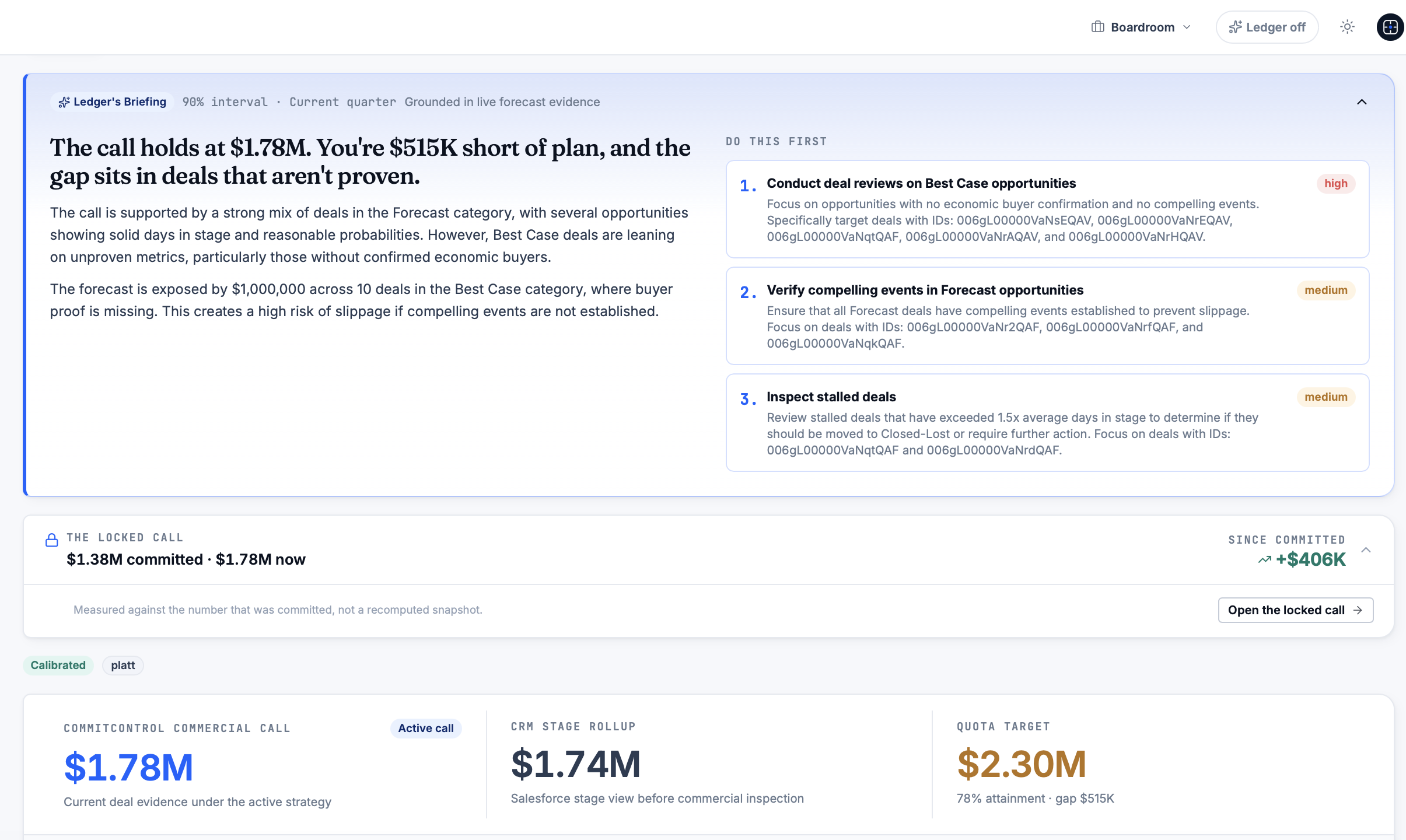
These solutions do not replace governance work or judgement calls described throughout this piece, and they do not require reps to change how they work. Instead, they provide the person running the review a faster, better-evidenced starting point, and a way to check earlier calls against what actually happened.
If that fits your next forecast cycle, book a demo-tenant forecast review or check current plans and pricing, which range from the Insight plan through to Enterprise.
Selected primary sources and authoritative reads
- Forrester on revenue operations intelligence, supporting the case that revenue operations intelligence is now core to a go-to-market stack.
- Gartner’s survey on sales analytics influence, supporting the governance-before-tools argument.
- Harvard Business Review on customer data transparency, supporting the data-trust framing.
- Research on AI forecasting accuracy, supporting the hybrid human-plus-model approach and vendor questions on MAPE and retraining.
- Firms such as benchmarked and TLC Consulting work with organisations on the data readiness and cross-functional coordination this strategy depends on.
Sources
- Forrester blog — revenue operations intelligence ROI
- Gartner press release on sales analytics influence
- HBR — Designing customer data for transparency and trust
- Fairview blog — AI revenue forecasting accuracy
FAQ
What does revenue intelligence do?
Revenue intelligence combines CRM data, engagement signals and analytics to rank which deals in a pipeline carry the most risk or material exposure, so a manager knows where to focus before a forecast call. On its own it does not make decisions: it gives a leader an evidence-based starting point for the judgement they still have to make.
What are the five key revenue drivers?
Definitions vary across sources, but most RevOps frameworks converge on pipeline generation, conversion rate through each stage, average deal size, sales velocity, and retention or expansion revenue. Tracking all five together, rather than any single one in isolation, gives a fuller picture of where a forecast is likely to miss.
What is RCA in Salesforce?
Root cause analysis (RCA) in a Salesforce context typically means tracing a missed forecast or a lost deal back to specific, logged reasons, such as a stalled stage or a missing stakeholder, rather than treating the miss as unexplained. A fixed set of reason codes captured during weekly reviews makes this analysis far easier to run consistently.
What are the three main types of revenue models?
The three most commonly referenced revenue models are subscription (recurring billing for ongoing access), transactional (one-off sales per unit or project), and usage-based (charges tied to actual consumption). Most B2B sales organisations selling software or services work primarily within the subscription model, sometimes blended with usage-based elements.
How do I start implementing a revenue intelligence strategy?
Start with a data-trust audit of your Salesforce fields, checking close-date completeness, stage discipline and activity logging before considering any tool. Once that baseline is in place, introduce a weekly pipeline inspection meeting with fixed reason codes, and only then evaluate technology that fits the cadence you have already built.
Recommended
Editorial content. All metrics are Salesforce-derived and reviewed for accuracy. Not a substitute for professional judgment.
See the same discipline applied to your pipeline.
CommitControl derives every figure from your own Salesforce data. Nothing is invented, and every number traces back to the record it came from. Connect Salesforce and the same view runs live on your data within 24 hours.
Evaluate CommitControl