Deterministic models take the same inputs and always return the same output: a fixed rule, a fixed score, a fixed verdict you can defend in a board meeting. Probabilistic models return a likelihood that shifts as data shifts, which makes them better at interpretation but weaker as the final word on a commit. For revenue and data teams, the practical answer is not to pick one camp: gate every audit critical decision with deterministic logic, and use probabilistic signals to inform judgement upstream of that gate.
TL;DR:
- Deterministic models are essential for decisions with high financial or reputational impact that require consistent, transparent results for audits or boards.
- Probabilistic models excel in handling messy, unstructured, or incomplete data by providing likelihoods that inform upstream risk flags, not final commitments.
- Combining both approaches in a hybrid system allows probabilistic signals to suggest candidates while deterministic rules gate final decisions, ensuring traceability and compliance.
- Regular calibration, rule versioning, and detailed evidence logs are critical for maintaining trust and defendability in probabilistic and hybrid models.
- Using deterministic guardrails reduces forecast drift and surprises, but probabilistic tools remain valuable for early risk detection and coverage extension.
Table of Contents
- Probabilistic vs deterministic: the takeaways that matter
- What is a deterministic model?
- What is a probabilistic model?
- Deterministic vs probabilistic forecasting: the practical differences
- How to choose between deterministic and probabilistic models
- Hybrid architectures: propose, then gate
- Revenue forecasting: what the choice actually costs you
- Why deterministic guardrails matter more as forecasting scales
- Commitcontrol: a commit number you can defend
- Sources
- FAQ
Probabilistic vs deterministic: the takeaways that matter
Most teams do not need a lecture on statistics. They need to know what to do differently on Monday morning. Here is the short version.
- Deterministic scoring is right whenever a wrong output has a financial or reputational cost you must explain to a board or auditor.
- Probabilistic scoring is right whenever inputs are incomplete, unstructured, or too noisy for fixed rules to hold up.
- If your forecast has changed substantially between the start and end of the quarter, that is not bad luck. It is usually a sign your scoring logic cannot survive scrutiny.
- Run this checklist before choosing a tool: Is the decision regulated or board reported? Is the input data structured (CRM fields) or unstructured (call transcripts, emails)? What does it cost you if the model is wrong? How fast do you need the answer?
- If the answer to the first two questions leans toward “regulated” and “structured,” require deterministic gating before committing to anything else.
- If it leans toward “unstructured” and “exploratory,” pilot a probabilistic layer, but do not let it own the final number.
The immediate next step is triage, not procurement. Work out which of your decisions are commit critical and which are exploratory, then match the model type to the decision, not the other way round.
What is a deterministic model?
A deterministic model runs on fixed, explicit rules. Feed it the same data twice and you get the same answer twice, every time, with no variance and no retraining drift. That single property, reproducibility, is what makes deterministic models the right tool whenever a number has to survive a board meeting or an audit.
Think about what “explain this forecast” actually demands. It is not enough to say a deal is 80% likely to close. Someone in the room will ask why, and the answer needs to trace back to something concrete: stage duration, engagement signals, contract status, all pulled directly from Salesforce fields. A deterministic model answers that question the same way every time it is asked, because the rule that produced the score is fixed and inspectable.
The trade off is brittleness. Deterministic rules need complete, structured inputs to work. If a required field is missing, blank, or inconsistently filled by a rep, the rule either fails closed or produces a result you cannot trust. That is a real limitation, and it is why deterministic models struggle with messy, unstructured data such as free text notes or call transcripts.
Deterministic mechanisms in a revenue context tend to look like this:
- A deal only counts as “commit ready” if stage, next step date, and economic buyer are all populated and consistent.
- A score drops automatically if a deal has skipped a stage in fewer than five business days.
- A forecast line locks once a set of CRM conditions are met, and unlocking it requires a logged, human override.
None of that requires statistical modelling. It requires good rule design and a direct line to your CRM data, which is exactly why deterministic systems tend to have low inference cost and high auditability, at the price of flexibility when the data is incomplete.
What is a probabilistic model?
A probabilistic model outputs a likelihood, not a verdict. A deal scored at “72% probability to close” is telling you something genuinely useful about pattern and precedent, but it is not telling you what will happen. Treating that 72% as near certainty is the single most common misreading of probabilistic tools, and it is where a lot of forecast trust gets lost.
That distinction matters because a probabilistic output is usually a conditional summary of a wider distribution, often the mean or median of many possible outcomes. Small shifts in underlying data can move that summary even when nothing material has actually changed in the deal, which is one reason forecasts built entirely on probabilistic scores can drift in ways that erode leadership trust.
Where probabilistic approaches genuinely earn their place is messy, unstructured, or sparse data: sentiment in call transcripts, engagement patterns across scattered touchpoints, or identity matching when a prospect’s details are incomplete across systems. Data teams commonly pair deterministic matching for high confidence identifiers with probabilistic methods to extend coverage where the clean identifiers simply are not there. That is the model doing what it is good at: filling gaps, not making final calls.
Running a probabilistic system properly costs more than people expect. Scores need calibration, meaning the underlying likelihoods have to be checked periodically against actual outcomes or they drift out of true. Outputs vary between runs as models retrain, which means monitoring is not optional. And transparency has to be built deliberately, because a raw probability score with no supporting reasoning is not something you can defend to a CFO.
When you are handed a confidence score from a commercial forecasting tool, the honest question to ask is not “how accurate is this?” It is “what would have to be true for this number to be wrong, and can I see that reasoning?” If the vendor cannot answer that plainly, treat the score as a hint, not a decision.
Deterministic vs probabilistic forecasting: the practical differences
The two approaches diverge across five dimensions that matter directly to revenue and data leaders: output, data requirements, flexibility, explainability, and cost.
Output. A deterministic model gives you a single verdict: this deal is commit ready, this one is not. A probabilistic model gives you a distribution or a likelihood, and someone still has to decide what threshold turns that number into an action. Classic forecasting literature formalises this: deterministic forecasts predict a single value, probabilistic forecasts predict a distribution, and one can be converted to the other by applying a threshold. That conversion step is where a lot of ambiguity quietly enters a sales process, because the threshold is a judgement call, not a fact.
Data requirements. Deterministic rules need complete, structured identifiers. If the CRM field is blank, the rule cannot fire correctly. Probabilistic methods tolerate fragmentation and gaps far better, which is exactly why identity resolution and matching problems lean probabilistic when data is scattered across systems and full deterministic matching is not possible.
Flexibility and maintenance. Deterministic systems require rule maintenance: when your sales process changes, someone has to update the rules, and that churn is visible and reviewable. Probabilistic systems require model maintenance: retraining, drift monitoring, and recalibration, work that happens less visibly and is harder for a non-technical stakeholder to audit. Neither is maintenance-free. They are just different kinds of upkeep, and the deterministic kind leaves a paper trail.
Explainability. This is the dimension that decides most vendor evaluations, and it deserves a table.
| Dimension | Deterministic | Probabilistic |
|---|---|---|
| Evidence for a decision | Replayable: same inputs, same output, every time | Statistical: requires calibration notes and confidence documentation |
| Who can audit it | Any stakeholder tracing rule to CRM field | Someone fluent in reading confidence intervals |
| Behaviour on missing data | Fails closed or flags the gap | Degrades gracefully, but silently |
| Best suited to | Commit decisions, compliance, board reporting | Risk flagging, sentiment analysis, coverage extension |
A deterministic score is replayable evidence: you can hand someone the rule and the CRM record and they arrive at the same number. A probabilistic score requires you to also hand over calibration history, which most vendors are reluctant to expose in detail, and most buyers are not equipped to interrogate.
Cost and risk. Deterministic inference is cheap to run and cheap to explain, but expensive to adapt when the business changes fast. Probabilistic inference handles novelty and scale better, but carries ongoing governance costs: monitoring, recalibration, and the risk that a distribution stops matching reality when it turns non-Gaussian. Academic work on forecast verification makes this point directly: deterministic verification strategies can become indefensible once the underlying distribution stops behaving normally, which is precisely when probabilistic thinking becomes necessary rather than optional.
How to choose between deterministic and probabilistic models
Four factors decide most real choices, and they rarely point in the same direction, which is why this needs a deliberate process rather than a gut call.
- Cost of being wrong. If an incorrect output costs you a board credibility hit, a compliance breach, or a mis-set customer expectation, that decision needs deterministic gating regardless of how good the probabilistic model’s headline accuracy looks.
- Regulatory exposure. If the decision touches financial reporting, GDPR obligations, or contractual commitments, you need a rule you can show a regulator, not a confidence interval you have to explain.
- Input type. Structured CRM fields with reliable population rates favour deterministic rules. Unstructured signals such as email sentiment or call notes favour probabilistic interpretation, at least as an input rather than a verdict.
- Latency and repeatability needs. If you need the same answer next Tuesday that you got today, with nothing having changed, deterministic wins by default.
When you are evaluating a vendor’s claims, ask three specific questions: Can you show me the evidence trail behind this score? Can I replay last quarter’s number and get the same result? Does every signal trace back to a field I recognise in my own CRM? If the answer to any of those is vague, treat the tool as an interpretation layer, not a commit engine.
Two operational rules are worth building into any system you adopt: fail closed when required data is missing rather than guessing, and version every rule change so you can explain why a score looked different in March versus June.
Pro Tip: Before signing anything, ask the vendor to walk you through one closed deal from last quarter, field by field. If they cannot show you exactly which inputs produced the score, you are buying a black box with a confidence interval attached to it, not a decision system.
Hybrid architectures: propose, then gate
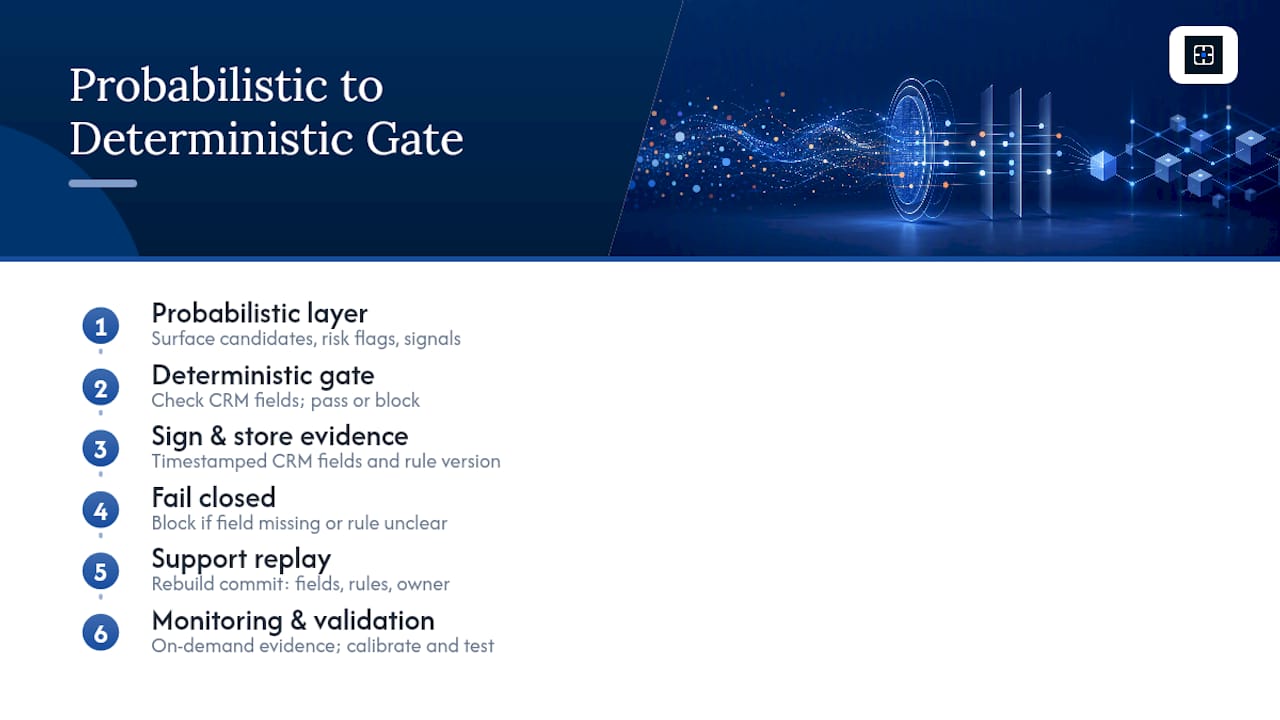
Industry practice has largely converged on one pattern: probabilistic layers propose, deterministic layers decide. The probabilistic side surfaces candidates, risk flags, or interpretive signals from messy data. The deterministic side checks those candidates against fixed rules tied to CRM records and either passes or blocks the decision. Nothing becomes a commit number until it clears the gate.
This works because it plays to each model’s strength. Enterprise architects increasingly treat probabilistic systems as interpreters and deterministic layers as controllers, which keeps interpretive power available without handing it final authority over numbers that get reported upward.
The gate itself needs to do three things well. It has to sign and store evidence: the exact CRM field values that triggered a pass or a block, timestamped and versioned. It has to fail closed: if a required field is missing or a rule version is ambiguous, the gate blocks the deal rather than guessing in its favour. And it has to support replay: anyone should be able to pull last quarter’s commit and see precisely which fields and rules produced it, with a human owner attached to the final decision.
On monitoring: engineering teams working with probabilistic components have noted that non-deterministic behaviour breaks the assumptions built into traditional observability tooling. You cannot just watch for errors the way you would with a fixed rule set. You need on-demand evidence retrieval, meaning you can pull the exact context behind any given score after the fact, not just a system health dashboard.
Validating the hybrid system means testing both halves independently: check the probabilistic layer’s calibration against real outcomes periodically, and check the deterministic gate’s rule logic against edge cases, particularly missing or conflicting CRM data. Log the rule version, the field values, and the human sign off every time. That log is what turns a model output into something you can defend twelve months later.
Revenue forecasting: what the choice actually costs you
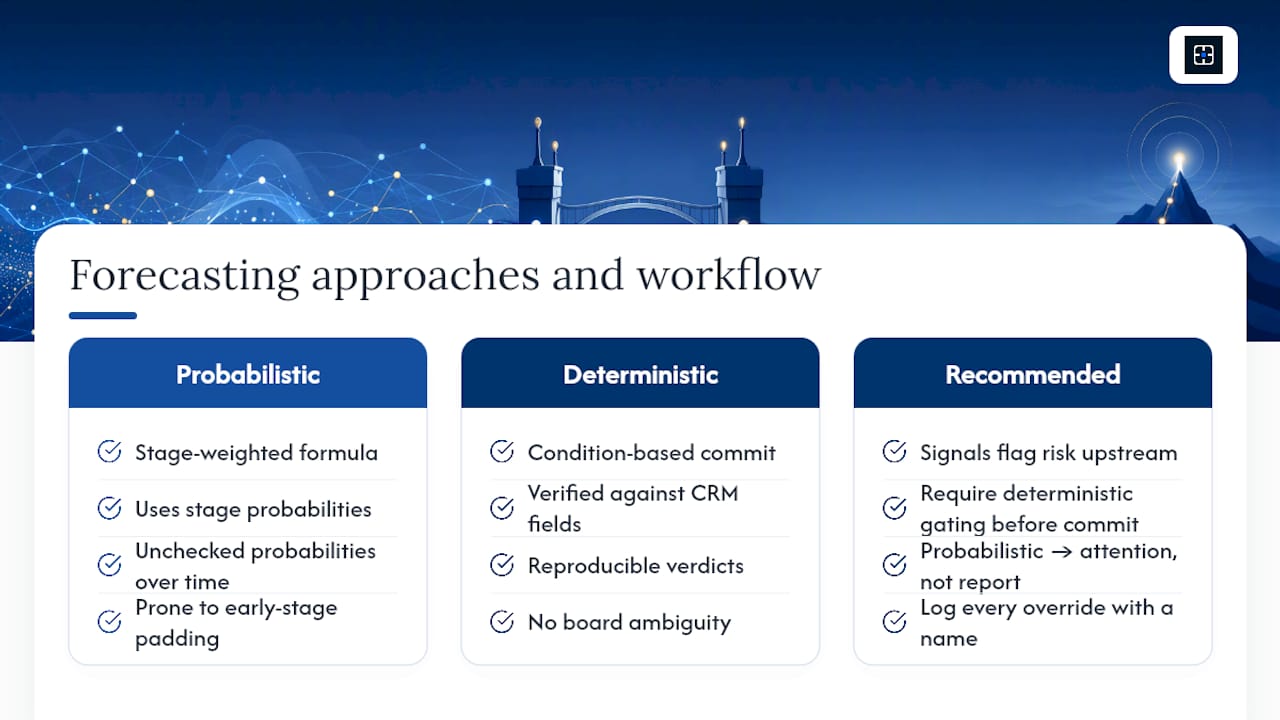
Here is the pattern that shows up in almost every mid-market forecast miss: the number called at the start of the quarter was £1.2m. What landed was £1.7m, or sometimes half that. Nobody lied. The stage-weighted average simply drifted because reps padded early-stage deals to look active, and a handful of late deals slipped after a stage change that nobody flagged as risk.
The mechanism is straightforward. Stage-weighted forecasting takes a probability associated with a pipeline stage and multiplies it against deal value. It is a probabilistic method dressed up as a simple spreadsheet formula, and it inherits every weakness of probabilistic scoring without any of the calibration discipline that makes probabilistic tools trustworthy elsewhere. Nobody checks whether “60% at proposal stage” still holds true. It just gets applied, quarter after quarter, until the forecast quietly stops matching reality.
A deterministic scoring layer changes what “commit ready” means. A deal only counts toward commit once fixed conditions are met and verified directly against CRM fields: next step logged with a date, economic buyer confirmed, no stage regression in the last reporting cycle. That verdict is reproducible. Pull the same deal in six months and, given the same field values, you get the same answer. There is no ambiguity to defend in the board meeting, because the reasoning is the CRM data itself.
Probabilistic signals still earn their place here, just not as the final number. Sentiment drawn from call notes, engagement decay across a stalled thread, unusual patterns in email response time: these are useful risk flags that tell a rep or manager where to look closer. They belong upstream of the commit decision, feeding attention and prioritisation, not downstream, deciding what gets reported to the board.
The recommended workflow for a mid-market CRO is simple to state and harder to enforce: let probabilistic signals flag risk early, require deterministic gating before anything counts as committed, and log every override with a name attached to it.
Why deterministic guardrails matter more as forecasting scales
Business outcome first: fewer forecast surprises come from better guardrails, not better guesses. The recommended posture holds across mid-market revenue teams: gate commit decisions with deterministic rules, use probabilistic tools for interpretation and coverage where data is thin, and never let a confidence score substitute for traceable evidence. Probabilistic methods still earn their place, particularly for surfacing risk in messy or incomplete data, and no team serious about forecasting should dismiss that value.
Brian’s credentials and relevant case study references to be added here.
— Brian
Commitcontrol: a commit number you can defend
Commitcontrol is the deterministic alternative to forecasting tools that ask you to trust a black box. Most enterprise platforms score deals with methods you cannot inspect and cannot replay months later. Commitcontrol does the opposite: every score traces back to specific Salesforce fields, every rule is versioned, and every commit decision has a human owner logged against it. Nothing changes in your reps’ day to day workflow.

If your forecast has ever moved from a confident number at the start of the quarter to an uncomfortable conversation at the end of it, that gap has a cost, and you can put a figure on it with the Sales Forecast Miss ROI Calculator. Teams navigating a sales leadership change, where forecast trust often resets to zero, can use the Reset the Forecast playbook to rebuild it deliberately rather than by accident. And if data governance and GDPR are part of your evaluation criteria, the security and EU data residency page covers exactly that. Start with the Commitcontrol product page and see what a board-defensible commit number actually looks like.
Sources
- Deterministic vs. Probabilistic AI: The Complete Guide (2026) - Elementum
- Deterministic vs. probabilistic models: Guide for data teams - RudderStack
- Forecast types and verification (David B. Stephenson / CAWCR)
FAQ
Is AI probabilistic or deterministic?
Most AI systems are probabilistic by default, producing likelihoods rather than fixed answers, but many production systems now add a deterministic layer to gate or validate those outputs before they trigger a real decision, as seen in hybrid architecture patterns.
What is the difference between probability and certainty?
Probability describes a likelihood that an outcome will occur, based on patterns in data, while certainty means a fixed, guaranteed result with no variance. Treating a high probability score as certainty is a common and costly misreading in forecasting.
When should you use deterministic models over probabilistic ones?
Use deterministic models whenever a wrong decision carries financial, regulatory, or reputational cost that has to be explained to a board, auditor, or compliance officer, particularly when your input data is structured and complete.
Can deterministic and probabilistic models work together?
Yes. The common industry pattern has probabilistic models propose candidates or risk flags from messy data, while a deterministic layer checks those against fixed rules and CRM records before anything becomes a final, auditable decision.
Does Commitcontrol use deterministic or probabilistic scoring?
Commitcontrol uses deterministic scoring, meaning every commit decision traces back to specific, verifiable Salesforce fields and produces the same result given the same inputs, rather than a variable confidence score.
Recommended
Editorial content. All metrics are Salesforce-derived and reviewed for accuracy. Not a substitute for professional judgment.
See the same discipline applied to your pipeline.
CommitControl derives every figure from your own Salesforce data. Nothing is invented, and every number traces back to the record it came from. Connect Salesforce and the same view runs live on your data within 24 hours.
Evaluate CommitControl