Pipeline risk analysis is the systematic assessment of which deals and forecast segments are likely to slip, stall, or close below commit. Done well, it turns a shaky number into a defensible one: fewer surprise misses, and a forecast you can walk into a board meeting and explain line by line. The reliable route to that outcome is auditable, explainable scoring, not another black-box probability.
TL;DR:
- Pipeline risk analysis relies on clear, auditable signals like stage age, activity frequency, and buyer contacts to identify deals at risk of slipping or stalling.
- Building deterministic scores based on verifiable Salesforce data ensures transparency, reproducibility, and compliance with explainability requirements.
- Regular weekly reviews should focus on high-risk deals with strong evidence, rather than relying solely on passive alerts or unvalidated flags.
- Implementing a simple, phased approach—including data audit, exit criteria, validation rules, and pilot testing—can deliver a functional program within weeks.
- Auditable scoring tools like Commitcontrol support accurate forecasting by providing traceable, defendable numbers that managers and board members can confidently explain.
Table of Contents
- Why forecasts miss and what real risk looks like in the pipeline
- Key signals to measure in Salesforce and how to instrument them
- Designing auditable, explainable scores: principles and the evidence you must keep
- Operating model: embed risk analysis into weekly pipeline reviews and manager accountability
- Governance, calibration and KPIs: prove the programme works
- Implementation checklist for Salesforce teams: steps to get started in weeks
- What twenty years of forecast misses taught me about trust
- Get an auditable forecast number, not another black box
- Sources
- FAQ
Why forecasts miss and what real risk looks like in the pipeline
A forecast called at £1.2 million that lands at £1.7 million is not good news. It means nobody understood the pipeline in the first place, and the miss just happened to run the right direction. Run it the other way and you’re explaining a shortfall to the board with no clean answer for why.
Most misses trace back to three habits, not bad luck. Opportunity stages are often subjective: two reps can call the same buyer conversation “Discovery” or “Proposal” depending on mood, not evidence. Once stage means whatever a rep wants it to mean, forecast rollups built on stage are worthless. Common mistakes in Salesforce forecasting trace this directly to weak or missing exit criteria.
Watch for these patterns weekly:
- Commit figures that jump week to week with no new contractual evidence behind the change.
- Close dates pushed more than once with no updated next step logged.
- Single-threaded deals where only one buyer contact has ever engaged.
- Deals sitting well past the typical duration for their stage with no activity logged.
Key signals to measure in Salesforce and how to instrument them
Deal health scoring works when it is built from a small set of signals that are cheap to pull from Salesforce and hard to fake. Deal health scoring guidance from RevOps practitioners recommends anchoring on stage age, next-step clarity, and buyer coverage before adding anything more elaborate.
Six signals earn their place in most pipelines:
- Stage age: days since the last stage change, compared against your historical average for that stage.
- Next meeting scheduled: whether a future meeting exists on the Opportunity or related Event records.
- Last activity: days since the last logged call, email, or meeting.
- Unique buyer contacts engaged: count of distinct Contact roles with logged activity, not just added to the deal.
- Close-date movement: number of times CloseDate has changed, and by how many days in total.
- Qualification completeness: how many fields in your MEDDPICC or equivalent checklist are actually filled, not left blank.
Build these from standard Opportunity, Activity, and Contact Role objects. A simple report grouping open deals by stage age against your historical stage duration will surface half your risk before you build anything else.
Pro Tip: Start with these six signals and resist the urge to add ten more in month one. A noisy score that nobody trusts gets ignored faster than a simple one that’s right most of the time.
Designing auditable, explainable scores: principles and the evidence you must keep
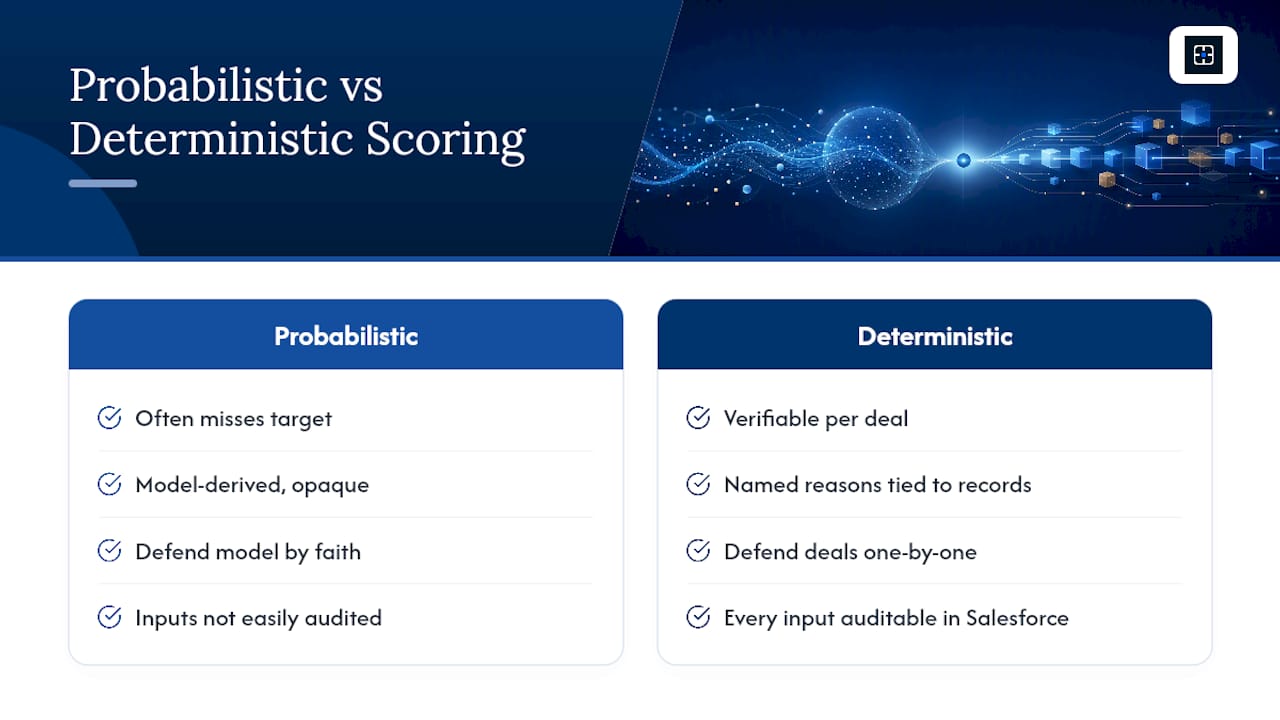
A score that changes overnight for reasons nobody can explain is worse than no score at all. Deterministic scoring solves this: the same Salesforce data always produces the same output, every time, for every deal. No random variation, no model drift between Tuesday and Thursday. If the score moved, something in Salesforce actually changed, and you can point to exactly what.

That matters more than most vendors admit. Enterprise buyers are now writing explainability requirements into procurement contracts, expecting vendors to produce a per-prediction explanation on demand, in language a non-technical stakeholder can follow. Most vendors relying on probabilistic models built on hidden feature weightings simply cannot meet that bar without exposing internals they’d rather keep proprietary.
Three rules make a score defensible:
- Deterministic logic, versioned. Record which rule set and input snapshot produced each score, so you can reproduce it a year later.
- Named risk factors, not a bare number. Every flagged deal should list its top two or three contributing reasons, each traceable to a CRM field or activity record.
- Human ownership, logged. Managers can override a flag, but the override and its rationale get recorded, not silently discarded.
Multi-signal scoring research found that flags paired with named risk factors and a recommended playbook drove 40 to 60% higher manager intervention rates than a bare score alone. A number without a reason gets ignored. A number with a reason gets worked.
Operating model: embed risk analysis into weekly pipeline reviews and manager accountability
A flag that sits in a dashboard nobody opens changes nothing. Deal health scoring exists to prompt human inspection, not replace it: the score is a starting question for the manager, never the final answer. Build the weekly review around that principle.
- Start with a fast health scan. Five minutes on the full pipeline: how many deals are flagged, and has that count moved since last week.
- Spend most of the time on the highest risk deals. Two or three deals, deep inspection: what’s the named risk factor, what’s the evidence, what’s the plan.
- Triage marginal flags quickly. A deal flagged for stage age but with a meeting booked next week probably doesn’t need floor time. Note it and move on.
Make a “Risk intervention plan” a required field on any deal that crosses your risk threshold. Review completion monthly, by manager, and treat a blank field the same way you’d treat a missing next step: unacceptable, not just untidy. Risk detection only pays off when it’s wired into workflow, meaning drafted follow-ups, scheduled tasks, and manager nudges, not a passive alert nobody actions, as research on deal risk scoring points out.
Governance, calibration and KPIs: prove the programme works
Never let a new scoring model touch forecast category on day one. Run it in shadow mode first: score every deal, log every flag, but change nothing about how the deal is forecast. Compare flags against actual outcomes for one full quarter before you trust the thresholds enough to act on them.
Four numbers tell you whether the programme is earning its place:
- Stalled-deal recovery rate: the share of flagged deals that get back on track after intervention.
- False positive rate: aim to keep this under 20%. Practitioner benchmarks point to that figure as a reasonable ceiling before reps start ignoring flags altogether.
- Time-to-flag: how many days before the close date a risk surfaces, versus how many days a manager needed to notice it unaided.
- Forecast accuracy lift: the gap between called and landed numbers, quarter over quarter, since scoring went live.
Retrain thresholds quarterly. Report manager compliance on intervention plans monthly. Segment every KPI by deal size and sales motion: a threshold tuned for £5,000 self-serve deals will misfire badly on a £500,000 enterprise negotiation.
Implementation checklist for Salesforce teams: steps to get started in weeks
You don’t need a quarter-long project to get a working version live. Most of the effort is in the CRM housekeeping, not the scoring logic itself.
- Audit your data first. Check stage duration history, exit criteria completeness, and how consistently reps log activity and Contact Roles.
- Define exit criteria per stage, replacing subjective judgement calls with specific, checkable buyer actions.
- Add validation rules that block a stage move forward without the exit criteria fields completed.
- Require key fields on commit deals: next step, next meeting date, and primary buyer contact.
- Pilot in shadow mode for six to eight weeks. Test one group receiving scores only against a second receiving scores plus named factors and a playbook, then compare intervention rates.
- Train managers on the weekly review agenda before scores go live in forecast conversations.
- Launch monthly manager compliance reporting on the Risk intervention plan field.
- Write a short playbook for each common risk factor: stalled stage age, single-threaded buyer, unexplained close-date push, so managers aren’t improvising a response each time.
Pro Tip: Assign one named owner per risk factor category. “Everyone’s responsible” for follow-up means nobody actually does it.
What twenty years of forecast misses taught me about trust
Every VP of Sales I’ve spoken with has a version of the same story: a number gets called with confidence, then lands somewhere else entirely, and the following board conversation is spent defending a model nobody in the room fully understands. That’s the real cost of probabilistic scoring. It’s not that the number is wrong. It’s that nobody can explain why, which makes every future number suspect too.
Auditable scoring changes that conversation. When a flag comes with named reasons tied directly to Salesforce records, a VP of Sales can walk into a board meeting and defend the number deal by deal, not on faith in a model. That’s the principle behind Commitcontrol, a revenue intelligence platform built specifically for Salesforce teams, using deterministic scoring so every input and calculation stays verifiable.
— Brian
Get an auditable forecast number, not another black box
Commitcontrol is the alternative to probabilistic forecasting tools for revenue teams who need to defend their number, not just report it. Every score is deterministic: the same Salesforce inputs always produce produces the same output, with named risk factors traceable back to the exact fields and activity records that drove the flag. Managers keep the final call, with every override logged.
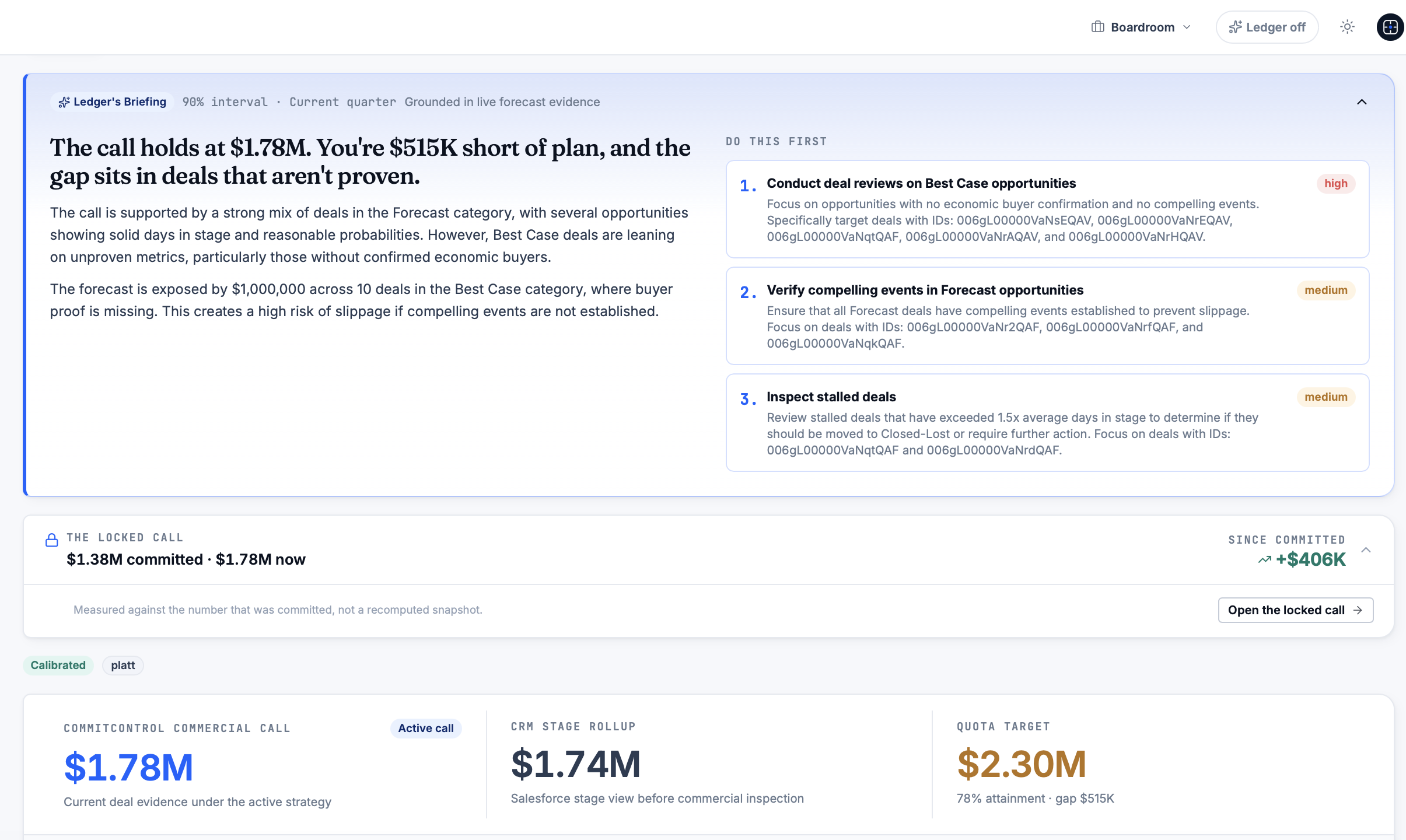
Data stays within the EU under GDPR-compliant residency, covered in full on the security and compliance page. If you want to see what a forecast miss like the one that opened this article actually costs your business, run the numbers through the Sales Forecast Miss ROI Calculator. If a leadership change is behind your current forecast uncertainty, the sales leadership transition programme is built for exactly that gap. For complex, high-value bids where financial exposure needs its own scrutiny, BidBlock offers a useful second layer of bid-specific risk insight alongside your pipeline scoring. When you’re ready to see it against your own pipeline, book a walkthrough of Commitcontrol.
Sources
- Deal health scoring: How RevOps flags pipeline risk
- How do you use ML scoring to flag at-risk deals in 2027?
- Common mistakes in sales forecasting in Salesforce
- Deal risk scoring in 2026 | The CRO’s early warning system
FAQ
What is pipeline risk analysis in sales forecasting?
It’s the assessment of which deals or pipeline segments are likely to slip, stall, or close below commit, using measurable signals like stage age, activity, and buyer coverage to flag risk before it hits the forecast.
How long does it take to implement a pipeline risk scoring programme?
A data audit and exit-criteria rebuild typically take a few weeks, followed by a six to eight week shadow-mode pilot before scores influence live forecast conversations.
Should the score replace manager judgement on a deal?
No. Deal health scoring is designed to prompt manager inspection, not decide the forecast automatically; a human should always own the final call and log any override.
How is Commitcontrol different from probabilistic forecasting tools?
Commitcontrol uses deterministic scoring, so identical Salesforce inputs always produce produce identical outputs, with named risk factors traceable to specific CRM evidence rather than a hidden model weighting.
Recommended
Editorial content. All metrics are Salesforce-derived and reviewed for accuracy. Not a substitute for professional judgment.
See the same discipline applied to your pipeline.
CommitControl derives every figure from your own Salesforce data. Nothing is invented, and every number traces back to the record it came from. Connect Salesforce and the same view runs live on your data within 24 hours.
Evaluate CommitControl