Hygiene is not a data-cleaning chore. It is a ritualised set of checks that make your pipeline numbers defendable when someone with a board seat asks why a forecast is significantly different from expectations. Run a weekly sweep lasting under an hour, enforce “next step plus date” on every open deal, and filter for deals with multiple pushed close dates. That single filter usually surfaces the fiction fastest.
TL;DR:
- Weekly pipe hygiene sweeps should be conducted every week with a clear owner, focusing on deals with no recent activity, past close dates, or multiple date pushes.
- Monthly audits must verify completeness of required fields, detect duplicate records, and review automation logs to prevent silent process errors.
- Quarterly reviews should re-align stage definitions with buyer evidence, prune unused custom fields, and ensure deals are accurately segmented by sales motion.
- Automation rules should include push counters, auto-close for stagnant early deals, and stage-entry timestamps to automatically enforce hygiene standards.
- Maintaining a deterministic scoring system allows clear, traceable explanations of forecast changes, preventing reliance on opaque models and supporting accurate leadership discussions.
Table of Contents
- The pipeline hygiene checklist, split by cadence
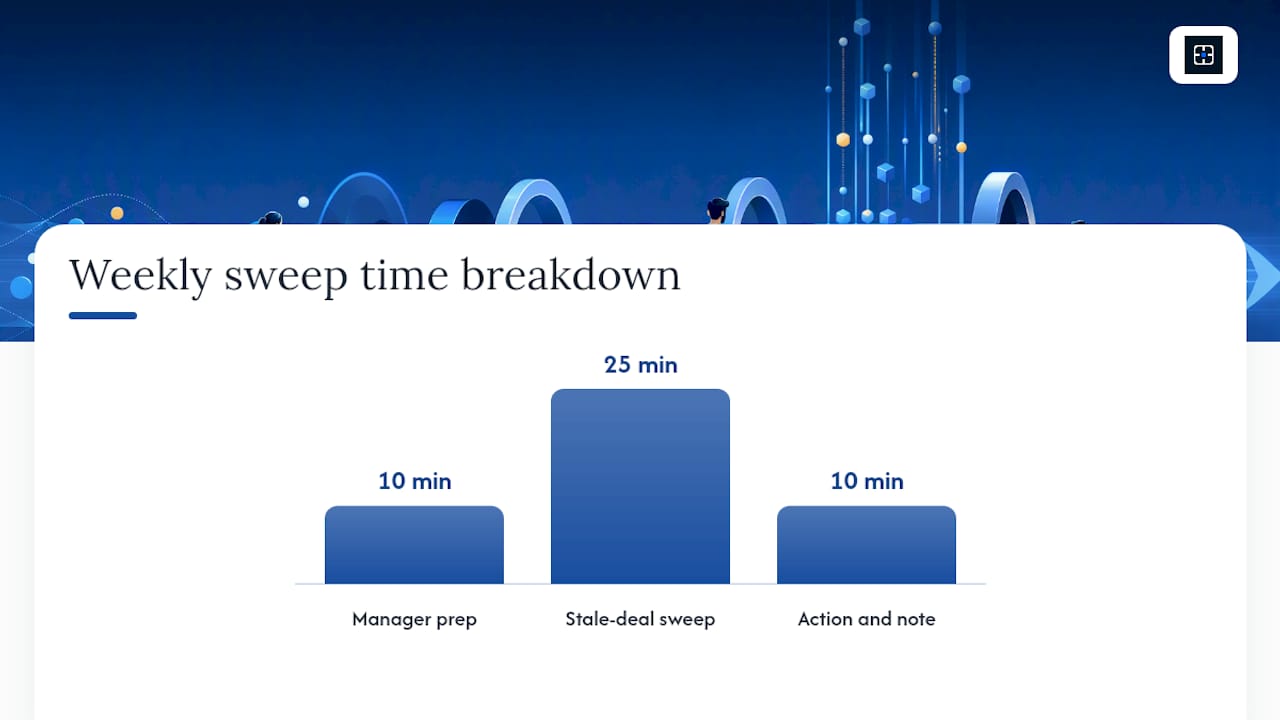
- How to run the weekly hygiene sweep in 45 minutes
- Monthly audit: fields, duplicates, and automation health
- The quarterly structural review your pipeline model needs
- Stage rules and data model essentials
- Automation recipes: push counters, auto-close, and timestamp alerts
- The KPIs that belong on your hygiene scorecard
- Defect remediation: who fixes what, and by when
- Why deterministic, auditable scoring keeps hygiene defensible
- What actually determines whether hygiene sticks
- Book a demo to see deterministic scoring on your own pipeline
- Sources
- FAQ
The pipeline hygiene checklist, split by cadence
A pipeline hygiene checklist only works if it has a clear owner and a fixed time slot. Without both, hygiene becomes “whenever we get to it,” which in practice means never. Here is the cadence that keeps a Salesforce pipeline honest without turning into a full-time job for someone.
Daily (rep, five minutes):
- Log the day’s calls, emails, and meeting outcomes before leaving the CRM
- Check any new record for missing amount, close date, or stage
- Confirm the next step field is filled with an action and a date, not “follow up”
Weekly (manager plus reps, 45 minutes):
- Pull the stale-deal filter: no activity in 14+ days, no next step, or a close date already in the past
- Decide on each flagged deal: re-engage, park, or close out
- Note the outcome in the deal record so the sweep has an audit trail
Monthly (RevOps or sales ops, half a day):
- Check required-field completion rates by stage
- Run a duplicate-record scan on new contacts and accounts
- Review automation logs for misfires that silently changed a field or stage
Quarterly (sales leadership, half a day):
- Re-anchor stage definitions to buyer evidence
- Audit which custom fields are still used and archive the rest
- Confirm deals sit in the correct pipeline for their product line or region
How to run the weekly hygiene sweep in 45 minutes
The weekly sweep is where most of the fiction gets caught, because it targets deals while they are still fresh enough to fix. This is the exact run sheet, adapted from the layered cadence approach used in published pipeline hygiene rituals.
- Manager prep (10 minutes). Run four saved filters: no activity in 14+ days, no next step recorded, close date in the past, and deals aged beyond their stage’s typical duration.
- Stale-deal sweep (25 minutes). Go through the flagged list with the rep who owns each deal, not alone. Context from the rep often changes the decision.
- Action and note (10 minutes). For each flagged deal, pick one of three outcomes: re-engage with a concrete next step and date, park it with a defined trigger to revisit, or close it out with a reason code.
The three-outcome rule matters because it removes the fourth, silent option: leaving a dead deal sitting in the pipeline because nobody wants to be the one who kills it. A pipeline with no “closed lost” activity for a month is not a healthy pipeline. It is a pipeline nobody is willing to be honest about.
Pro Tip: Run the sweep at the same time every week, ideally right before the forecast call, not after it. If you run it after, you have already reported the fiction to leadership.
Close-date discipline deserves its own line item inside this ritual. Every time a rep pushes a close date, that should register somewhere countable. A deal pushed once is normal. A deal pushed four times in a quarter is a pattern, and patterns are what a hygiene sweep exists to catch.
Monthly audit: fields, duplicates, and automation health
Weekly sweeps catch dead deals. Monthly audits catch the process gaps that create them in the first place, things like a stage that lets reps advance without an amount, or a workflow rule quietly overwriting a forecast category. Best practice guidance on ETL and pipeline testing applies just as well to a CRM: testing changes before they hit production prevents exactly this kind of silent regression.
Three checks belong in every monthly audit:
- Required-field completion by stage. Measure the percentage of open deals with amount, close date, and next step filled in at each stage. If completion drops below 90% in any stage, that stage’s entry criteria need re-enforcing, not just a reminder email.
- Duplicate detection. Run a dedupe scan on records created or updated that month. A monthly pass is the right frequency for this: often enough to catch drift, not so often it becomes noise. Merge with a logged reason, never a silent delete.
- Automation and workflow review. Pull the automation logs and check for misfires: a workflow rule that changed a forecast category on the wrong trigger, or a stage-advance automation that fired without the required field being set.
Disqualified and abandoned deals need the same monthly attention. If a deal has sat in “closed lost” limbo without a reason code for more than 30 days, that is a hygiene defect just as much as a stale open deal is.
The quarterly structural review your pipeline model needs
Weekly and monthly rituals keep the data clean. The quarterly review keeps the model honest, and this is the one most sales teams skip until the forecast has already gone wrong twice.
- Stage definitions. Re-anchor every stage to observable buyer evidence, not rep intuition. If “Stage 3: Proposal Sent” can be true without a proposal actually being sent, the stage definition has drifted.
- Property impact analysis. List every custom field on the opportunity object. For each one, check whether it is actually used, referenced in a report, or tied to an automation. Archive the rest. Unused fields are where forecast confusion hides.
- Pipeline segmentation. Confirm deals sit in the pipeline that matches their actual sales motion. A self-serve deal tracked in an enterprise pipeline distorts both pipelines’ averages.
This quarterly pass is structural maintenance, not busywork. Data integrity, as defined by NIST’s technical standard, rests on correctness and consistency over time, and a pipeline model that nobody revisits drifts out of both within two or three quarters.
Stage rules and data model essentials
Most pipeline gaming happens because stages are defined by feeling rather than evidence. A rep believes the deal is going well, so they move it to the next stage. Fix the definition, and you remove most of the ambiguity that makes gaming possible.
Each stage needs a buyer-evidence example attached to it: not “rep believes budget exists” but “buyer has shared a budget range in writing.” That single change, recommended in practical pipeline-hygiene playbooks, removes most of the subjectivity from stage advancement.
Minimal required fields matter too, but fewer is better than more. Insight from teams that have run this well is consistent: start with the simplest enforceable rule, typically “next step plus date,” and only add fields once that one rule is holding. Layering ten required fields onto a team that cannot yet keep one field current guarantees they will fake all ten.
Three enforcement patterns work without turning your CRM into a bureaucracy:
- Manager approval gates on stage advancement into late-stage categories, where a wrong advance does the most forecast damage.
- Locked opportunity creation fields, so amount and close date cannot be left blank at creation.
- Standardised note templates for stage changes, so the audit trail reads the same way across every rep.
Stage timestamps and push counters, covered next, are what turn these rules from policy into something the system enforces automatically.
Automation recipes: push counters, auto-close, and timestamp alerts
Rules that rely on rep memory decay within a quarter. Automation is what keeps hygiene running when nobody is actively policing it, and it is where tested, staged rollouts matter most, because a bad automation rule can do more damage than the fiction it was meant to catch.
- Push-counter recipe. Build a workflow that finds any open deal with a close date in the past, pushes it forward by 30 days, and increments a “Push Counter” field by one. Give managers a filter for any deal with a Push Counter above a certain threshold. That filter, in most pipelines, finds the deals nobody wants to talk about.
- Auto-close for stagnant early-stage deals. For deals sitting in Stage 0 or Stage 1 beyond a set threshold with no activity, auto-close with a reason code, but give managers an override checkbox and send a warning email first. Automation should enforce hygiene, not replace the coaching conversation, so a manager override before auto-closing matters more at later stages than early ones.
- Timestamp and alert properties. Add a timestamp field that fires the moment a deal enters each stage, then set an alert when a deal exceeds that stage’s typical duration. Re-enrol the alert if the deal moves stage or gets a genuine activity update.
Pro Tip: Test every automation recipe in a sandbox before deploying it live. A push-counter rule with the wrong filter logic can quietly reset every close date in your pipeline overnight, which is a worse problem than the one you started with.
The KPIs that belong on your hygiene scorecard
A scorecard turns hygiene from a vague sense of “the data feels off” into numbers you can act on, and gate meetings around.
- Percentage of opportunities with a mutual next step and date. A low percentage signals the “next step plus date” rule is not holding.
- Percentage with no activity in 14+ days. Rising month over month means the weekly sweep is not catching what it should.
- Close-date slip rate. How many deals push past their original close date, and by how much.
- Contact completeness. Missing or unverified contact records on active deals.
- Pipeline coverage ratio. Total pipeline value against quota, checked against your team’s historical conversion rate.
When three or more of these metrics run red at once, that is the signal to stop selling and clean, at least for that segment. Published scorecard guidance recommends exactly this kind of gate before forecast meetings: review the scorecard in the weekly sweep, escalate persistent red flags to the monthly audit.
Defect remediation: who fixes what, and by when
Finding hygiene defects without a fix process just produces a longer list of problems nobody owns. A remediation queue closes that gap.
- Weekly defects (stale deals, missing next steps): owner is the rep’s manager, SLA of 48 hours.
- Monthly defects (field gaps, duplicates, automation misfires): owner is RevOps, SLA of one week.
- Quarterly defects (stage drift, unused fields, segmentation errors): owner is sales leadership, SLA of the following quarter’s planning cycle.
A remediation queue with a defined SLA and a directly responsible individual keeps fixes visible instead of letting hygiene work slip into an untracked backlog. Run a bi-weekly remediation check until the metric in question is back to baseline, then drop it to monthly monitoring.
Treat remediation as a coaching signal, not a punishment log. A rep who consistently has stale deals usually has a territory or qualification problem, not a discipline problem. Fix the process, not just the deal.
Why deterministic, auditable scoring keeps hygiene defensible
Hygiene checklists tell you what to fix. They do not, on their own, tell you whether the resulting pipeline number will survive a hard question in a board meeting. That is where scoring method matters. A deterministic score means identical inputs always produce identical outputs: no variance run to run, and every signal traceable back to a specific field in Salesforce.
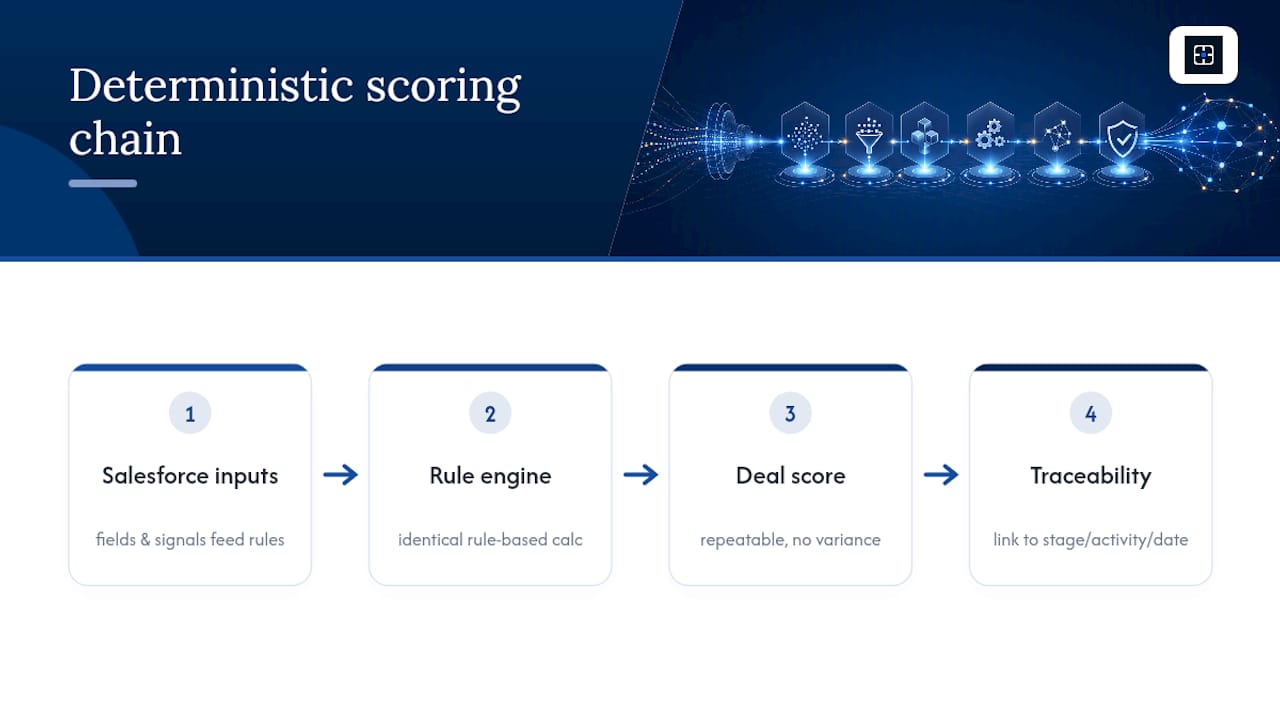
That traceability is the practical payoff. When a deal’s score changes, you can point to the exact stage change, activity gap, or close-date push that caused it. Root-cause analysis on a forecast miss takes minutes instead of a week of spreadsheet archaeology. This scoring principle can be reviewed in more detail on the security and data residency page.
What actually determines whether hygiene sticks
Start small. Pick one team, run the weekly ritual for two months, and resist the urge to roll every rule out to every team at once. Fewer rules enforced consistently beat a comprehensive checklist that gets ignored by week three. Once hygiene metrics are stable, use them directly in leadership conversations: not “trust me, the forecast is right,” but “here is the scorecard, here is what changed, here is why.”
— Brian
Book a demo to see deterministic scoring on your own pipeline
Most vendors selling forecast accuracy rely on models you cannot fully inspect: a score changes and nobody on the revenue team can say exactly why. That opacity is fine until a board member asks a hard question mid-quarter. Commitcontrol takes a different route: every score is deterministic, meaning the same inputs always produce the same output, and every signal traces back to a specific field or activity in Salesforce.
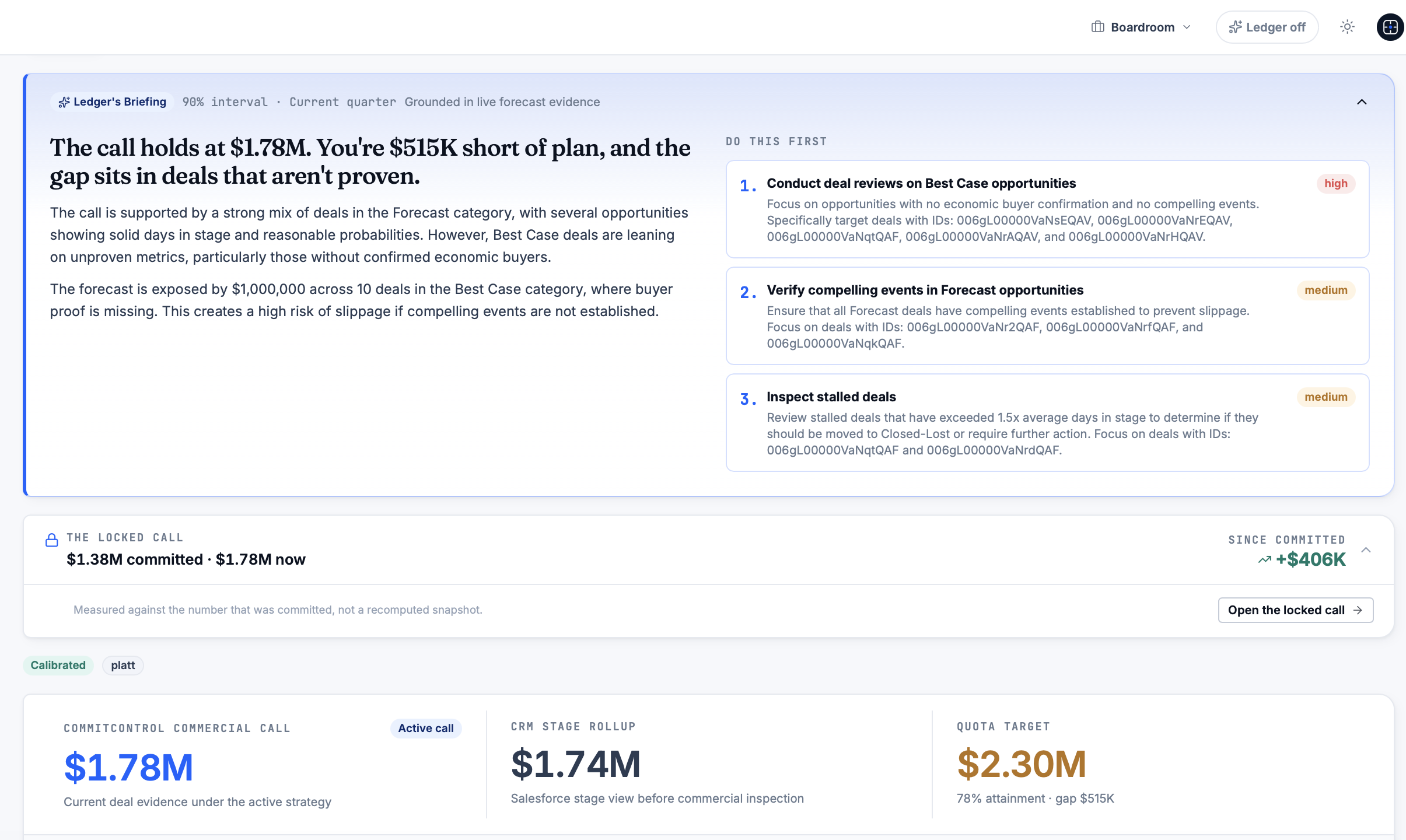
For a VP of Sales who has already run the checklist above and still wants a system watching for drift between sweeps, Commitcontrol operationalises the same discipline: audit trails on every score change, EU data residency and GDPR handling detailed on the security page, and no change to how reps already work in Salesforce. If your team is mid-transition or actively rebuilding trust in the number, the sales leadership transition guide walks through how to reset a forecast without guessing. Run the numbers on what a forecast miss actually costs using the ROI calculator, then book a walkthrough on the Commitcontrol product page to see a live deal scored against your own Salesforce data.
Sources
- Pipeline Hygiene: The 2026 Playbook for Clean Data
- Master Pipeline Hygiene Checklist with Proven | FreshDay CRM
- ETL best practices: testing, observability, idempotency (IBM)
- NIST: data integrity definition
FAQ
What are the five stages of a sales pipeline?
Most B2B pipelines run through Prospecting, Qualification, Proposal, Negotiation, and Closed Won or Closed Lost, though exact labels vary by company. What matters more than the labels is that each stage has a buyer-evidence rule attached, so advancement reflects the buyer’s behaviour rather than the rep’s optimism.
What is a good sales pipeline ratio?
Pipeline coverage ratio compares total open pipeline value to quota, and healthy ratios vary by industry, deal size, and historical conversion rate rather than one fixed benchmark. Track your own ratio against your team’s actual close rate over several quarters rather than borrowing a generic target.
What does CRM data hygiene mean?
CRM data hygiene means keeping records accurate, complete, and current: correct field values, no duplicate contacts or accounts, and deal data that reflects reality rather than a rep’s best guess. It is maintained through recurring checks rather than a one-time clean-up.
What is a pipeline hygiene checklist, and how does it differ from a cyber hygiene checklist?
A pipeline hygiene checklist covers CRM data quality, such as stale deals, missing next steps, and duplicate records, run on a weekly, monthly, and quarterly cadence. A cyber hygiene checklist covers a different domain entirely: security basics like patching, access controls, and password policy, so the two share a name but not a subject.
How does deterministic scoring help defend a forecast?
Deterministic scoring means identical CRM inputs always produce the same score, with every signal traceable to a specific Salesforce field, which lets a revenue leader explain exactly why a number changed rather than defending a model nobody can fully inspect. Commitcontrol builds its forecast scoring on this principle.
Recommended
Editorial content. All metrics are Salesforce-derived and reviewed for accuracy. Not a substitute for professional judgment.
See the same discipline applied to your pipeline.
CommitControl derives every figure from your own Salesforce data. Nothing is invented, and every number traces back to the record it came from. Connect Salesforce and the same view runs live on your data within 24 hours.
Evaluate CommitControl