Evidence-based forecasting means scoring every deal with fixed rules applied to your own Salesforce history, so the same inputs always produce the same score and every number traces back to a field you can open and check. The immediate payoff is a commit figure you can defend line by line in a board meeting, not one you hope will survive the first hard question. Get there with clean stage mappings, deterministic rules, and clear ownership of every override.
TL;DR:
- Evidence-based forecasting relies on fixed, Salesforce-specific rules, ensuring every deal score is reproducible and directly linked to record changes.
- Data hygiene issues like stale close dates and untracked stage changes are the main causes of inaccurate forecasts, often costing millions annually.
- Building an accurate forecast requires profiling OpportunityHistory data, locking stage mappings, and back-testing rules against past closed deals, including lost opportunities.
- The forecast validation process should include detailed receipts, dashboards, deviation explanations, and logs of managerial overrides to maintain transparency.
- Successful implementation depends on regular ownership of data quality by designated roles and disciplined governance around stage and override adjustments.
Table of Contents
- What evidence-based forecasting actually means in practice
- Why forecasts go wrong today
- How to build an evidence-based forecast in Salesforce
- Building the evidence pack for the forecast meeting
- Operational checklist: roles, cadence, and metrics
- A sales leader’s case for deterministic scoring
- How CommitControl operationalises evidence-based forecasting
- Sources
- FAQ
What evidence-based forecasting actually means in practice
Most forecast tools give you a probability and ask you to trust it. Evidence-based forecasting works differently: it scores a deal using only your company’s own Salesforce data, applying fixed rules that never change unless you change them. Feed the same opportunity history through the model twice, and you get the same score twice. That sounds obvious. It is not how most enterprise tools work.
Probabilistic black boxes calibrate across thousands of other companies’ deals, blending your pipeline with patterns from businesses that sell nothing like what you sell. You cannot inspect the weighting.
Deterministic scoring flips that. Every score ties to a specific Salesforce field: a stage change recorded in OpportunityHistory, a close date pushed twice, an amount edited after the quote went out. Traceability is not a feature bolted on afterwards. It is the mechanism itself: the rule fires because the field changed, and you can point to the exact change every time.
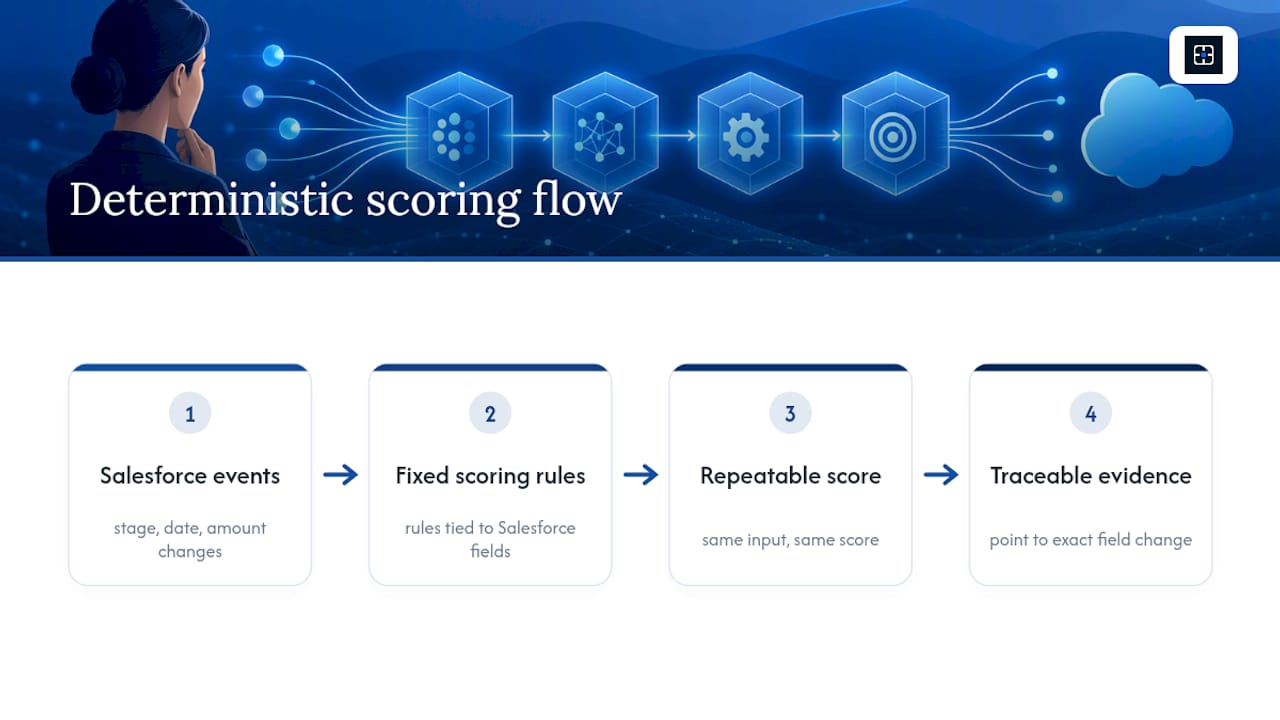
For a VP of Sales walking into a forecast review, that difference decides whether the meeting is a defence or an argument.
Why forecasts go wrong today
The failure usually starts before anyone touches a forecast tool. A CRO calls the quarter at £1.2 million. It lands at £1.7 million, or worse, £800,000. Nobody can say why with certainty, because the number was built on data nobody checked.
Four causes show up again and again:
- Poor data quality. Gartner puts the average cost of poor data quality at $12.9 million a year for the organisations it studied. Stale close dates and missing amounts feed directly into forecast rollups.
- Loose stage-to-forecast mappings. Salesforce lets you edit how stages map to Pipeline, Best Case, Commit, and Closed categories, and that mapping often drifts between teams or gets changed without anyone updating the forecast logic to match.
- Rep-driven adjustments. A rep moves a deal to “Commit” to hit a number for the week, not because the buyer signed anything. The forecast category rolls up instantly. Nothing in the system flags that the move was judgement, not evidence.
- Lagging indicators. Standard reporting is a snapshot. It shows where deals sit today, not the velocity or stage history that would tell you whether that position is earned or padded.
A 2024 Gartner survey of 303 sales leaders found that 84% said analytics had less influence on performance than leadership expected. Poor data quality was cited by 44% of them as a top barrier. That is not a tooling problem. It is a hygiene problem wearing a tooling disguise.
How to build an evidence-based forecast in Salesforce
Fixing this is not a rip-and-replace project. It is a sequence, and the order matters.
- Profile your OpportunityHistory data first. Before you write a single scoring rule, pull OpportunityHistory and look for the patterns that will break any model: stages skipped, close dates pushed repeatedly, amounts changed after commit. You are looking for where the data lies, not where it tells the truth.
- Lock your stage-to-category mappings. Decide, once, which stage maps to which forecast category and which probability default applies. Document it. Stop letting individual managers adjust it on the fly.
- Write deterministic scoring rules against named fields. A rule should read like a sentence a auditor could follow: “if close date has moved twice in 14 days and stage has not advanced, flag as at risk.” No hidden weighting. No black box.
- Assign governance. Decide who can edit a stage mapping, who can override a score, and where the reason for that override gets recorded. Without this, your deterministic system degrades into the same guesswork it replaced.
- Back-test against last year’s closed deals. Run the rules against opportunities that already closed. If the rules had called last quarter accurately, trust them with this one. If not, adjust the rules, not the outcome.
Pro Tip: Run your back-test on deals that closed lost, not just closed won. A scoring system that only proves itself on wins has never been tested against the deals that actually damage your forecast.
Building the evidence pack for the forecast meeting
A defensible number needs a paper trail, not just a total. When someone in the room asks why a deal is flagged red, the answer should take one click, not a phone call to the rep.
Build the pack around four elements:
- Per-deal receipts. Every score should carry the field change, the timestamp, and a one-line rationale, something Gartner’s own guidance on pairing analytics with qualitative context supports directly: a number without a reason convinces nobody.
- Dashboards that drill into the record. A summary chart is a starting point. The real trust-building moment is clicking through to the actual Salesforce opportunity behind the number.
- A script for deviations. When a deal’s score disagrees with a rep’s gut call, have a fixed way of explaining the gap: which field triggered the flag, what evidence supports the rep’s view, and who decided the final call.
- A visible log of manager adjustments. If a manager overrides a deterministic score, that override needs the same audit trail as the original score. Otherwise you have rebuilt the black box one layer down.
The ForecastingItem object is useful here specifically because it flags HasAdjustment and stores both adjusted and unadjusted amounts, so you can show a board exactly where a human touched the number and why.
Operational checklist: roles, cadence, and metrics
Deterministic scoring only holds up if someone owns the hygiene behind it every week, not just at quarter-end.
- Data steward: owns field completeness and flags stale records daily.
- RevOps: owns the scoring rules, mapping changes, and back-testing cadence.
- Sales managers: own override decisions and the written reason behind each one.
Track three data-quality signals weekly: field completeness, stage drift against the locked mapping, and the count of close dates pushed more than once in a rolling 30-day window. Run deal reviews on a fixed cadence, not an ad-hoc one, and require a documented reason for any override outside the rules.
Gartner’s own research puts the average cost of poor data quality at $12.9 million a year for the organisations it studied. That figure is the business case for the hygiene work above: skipping it does not save time, it defers the cost to the quarter when the forecast collapses.
A sales leader’s case for deterministic scoring
I would rather walk into a board meeting with a number I can defend field by field than one built on a model nobody in the room can question. Human judgement still matters: a rep’s read on a stakeholder change is real evidence, and it belongs in the record with a name and a date attached, not buried inside an algorithm’s weighting. But deterministic scoring only earns that trust with disciplined data hygiene behind it. Skip the governance, and you have just built a smaller black box.
— Brian
How CommitControl operationalises evidence-based forecasting
CommitControl builds deterministic, Salesforce-tied scoring with a per-deal receipt behind every number: the field that changed, when it changed, and the fixed rule that fired because of it. Nothing calibrates across other tenants’ data and nothing needs your reps to change how they work in Salesforce.
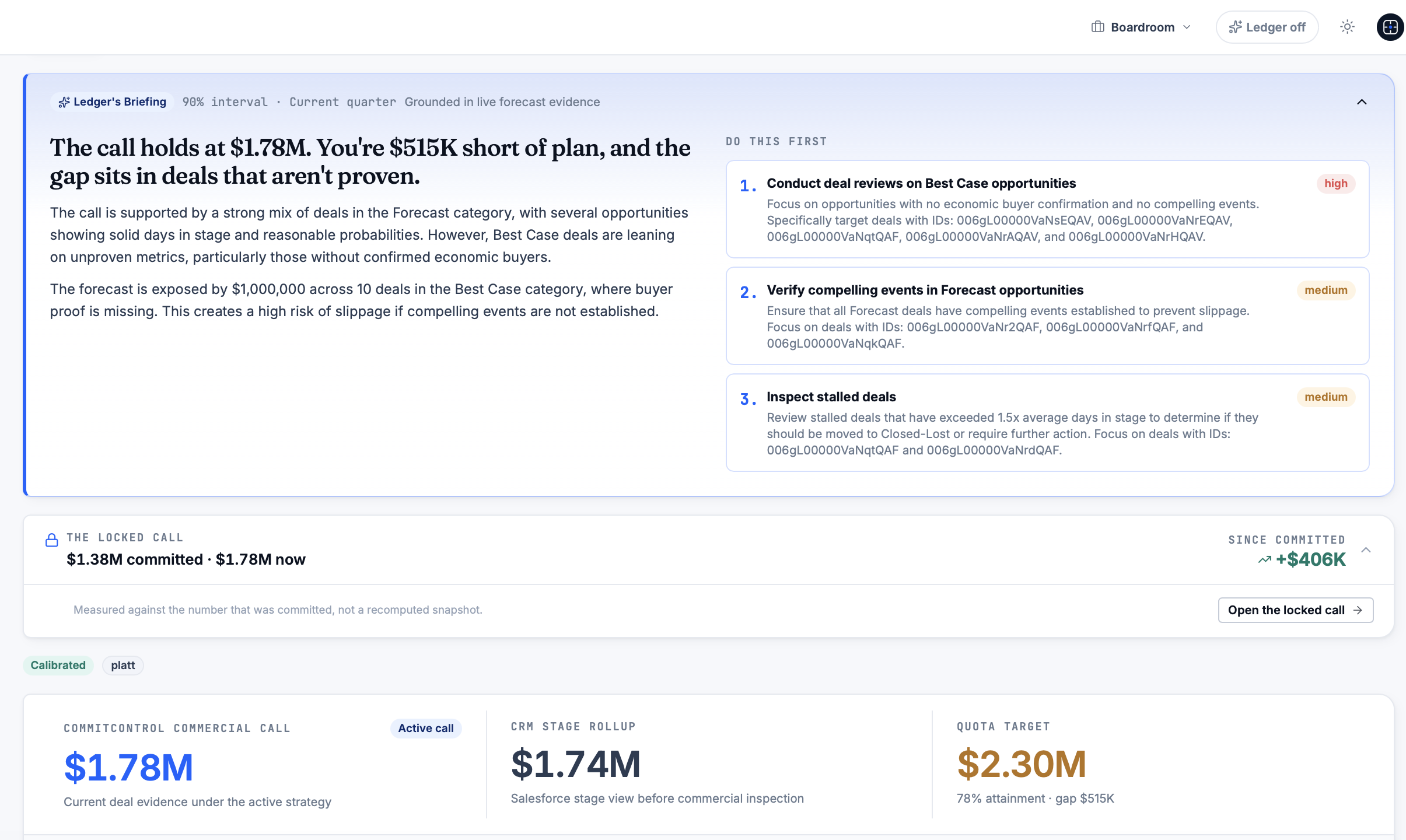
If your team is mid-transition, the Sales Leadership Transition solution is built specifically for resetting a forecast when a new leader inherits a pipeline nobody trusts yet. And if you want to put a figure on what a bad forecast actually costs your business before you invest in fixing it, the Sales Forecast Miss ROI Calculator does that arithmetic for you. Current pricing details are available on the CommitControl pricing page. Book a demo and bring your last quarter’s forecast: the receipts will tell you exactly where it went wrong.
Sources
Share these with whoever owns your Salesforce configuration before you start building rules: the OpportunityHistory field reference, the stage-to-forecast-category mapping guide, and Gartner’s research on sales analytics and forecasting. For a partner view on keeping decisions auditable, Betlog applies the same receipts-first thinking to a different category of decisions.
- Gartner press release: 2024 survey on sales analytics influence
- Gartner: data quality research and guidance
- Salesforce Developers: OpportunityHistory field reference
- Salesforce Help: Manage opportunity stage to forecast category mappings
FAQ
What is evidence-based forecasting?
It is a forecasting method that scores each Salesforce opportunity using fixed, deterministic rules applied only to your own CRM history, so every score is reproducible and traceable to a specific field or event. It replaces probabilistic black-box scoring with logic a revenue leader can inspect and defend.
How long does it take to implement?
The timeline depends on how clean your Salesforce data already is. Data profiling and stage-mapping cleanup typically take longer than writing the scoring rules themselves, so most of the effort sits in hygiene, not configuration.
Does this replace manager judgement in forecast calls?
No. Deterministic scoring gives you the evidence layer; managers still add qualitative context, particularly around stakeholder relationships and competitive dynamics. Gartner’s guidance on pairing analytics with process supports combining both rather than choosing one.
How much does CommitControl cost?
Current pricing details are available on the CommitControl pricing page. Enterprise pricing is available on request.
What Salesforce data does this rely on?
Primarily OpportunityHistory for stage and field changes, and ForecastingItem for forecast amounts and adjustment flags. Both are standard Salesforce objects, so no separate data warehouse is required.
Recommended
Editorial content. All metrics are Salesforce-derived and reviewed for accuracy. Not a substitute for professional judgment.
See the same discipline applied to your pipeline.
CommitControl derives every figure from your own Salesforce data. Nothing is invented, and every number traces back to the record it came from. Connect Salesforce and the same view runs live on your data within 24 hours.
Evaluate CommitControl