The most defensible forecast is one you can show with receipts. AI sales forecasting can produce more accurate, timely revenue numbers, but only when the underlying data is clean and the rollout includes human governance. Get those two things wrong and the model just automates the guesswork you already had. CommitControl’s deterministic approach is one way to keep every score traceable back to Salesforce, which matters more than raw accuracy claims once you’re standing in front of the board.
TL;DR:
- Accurate AI sales forecasting depends on clean, consistent data, especially full stage change histories, activity logs, decision-maker contacts, and dynamically updated close dates.
- Continuous model updates based on real-time deal activity and transparent, traceable scores provide more reliable forecasts aligned with actual pipeline movements.
- Shadow mode testing for at least one quarter helps build trust before full deployment, with ongoing retraining to maintain accuracy during operational use.
- Validating forecast accuracy through metrics like MAPEs, bias, and forecast value added ensures the model genuinely improves over simple historical or stage-weighted methods.
- Implementing deterministic scoring from tools like CommitControl offers clear, board-friendly evidence of forecast rationale, especially useful during leadership transitions or audit reviews.
Table of Contents
- What is AI sales forecasting, and how is it different from what you do now?
- What are the real benefits for a sales leader?
- How much clean data do you actually need first?
- How do AI forecasts turn into numbers you can act on?
- What’s the rollout path from data audit to live forecasts?
- How do you know if the forecast is actually working?
- How does CommitControl fit into this?
- What a VP sales should actually expect from this
- Ready to see a forecast you can defend line by line?
- Sources
- FAQ
What is AI sales forecasting, and how is it different from what you do now?
You called $1.2M. You landed $1.7M. Or worse, the other way round. Ask your VP why, and you get a story about a deal that “felt strong” or a rep who “always sandbags.” That’s not forecasting. That’s narrative building, and it collapses the moment a board member asks for the reasoning behind a specific number.
AI sales forecasting replaces the story with a calculation. Instead of a rep assigning a deal to “Commit” or “Best Case” based on gut feel, the system calculates a probability of closing for every open deal, based on patterns in your historical CRM data. Multiply each deal’s value by its probability, add them up, and you get an expected revenue figure. That’s a fundamentally different number to a stage-weighted rollup, where every deal at “Proposal” gets the same 60% regardless of how it actually behaves.
The core mechanical differences:
- Stage-weighting treats all deals in a stage as equal. A $500K deal and a $50K deal sitting at “Negotiation” both get the stage’s default probability, even though they behave nothing alike.
- Rep estimates are inconsistent by design. One rep pads their commit to look safe. Another inflates it to look strong. Neither number is wrong, exactly. Neither is verifiable either.
- AI-driven revenue forecasting updates continuously. A deal that goes quiet for ten days, or has its close date pushed twice, shifts its score immediately, not at the next pipeline review.
That last point changes the forecasting meeting itself. Instead of debating whose gut feel is right, the conversation moves to reviewing which deals moved and why. HubSpot’s own AI projection tooling works on this basis, issuing a most likely, upper, and lower range rather than a single false-precision figure, and it explicitly warns that projections only hold up when closed-won data is accurate and current. That warning is the whole article in one sentence.
What are the real benefits for a sales leader?
Better forecasts aren’t the point. Fewer surprises in front of the board is the point. Accuracy is just the mechanism.
Here’s what actually changes operationally when predictive sales analytics is running well:
- Risk surfaces earlier. A deal with no activity in three weeks and a close date that’s slipped twice gets flagged before it dies quietly in “Best Case,” not after.
- Coaching gets targeted. Instead of reviewing every deal in a rep’s pipeline, you review the five where the model and the rep disagree. That’s where the real coaching value sits.
- Quota conversations get evidence. When a rep pushes back on their number, you’re pointing at the same signals they can see in Salesforce, not overriding them with authority.
- Scenario planning gets faster. “What if the two largest deals slip a quarter?” becomes a calculation you can run in minutes, not a spreadsheet exercise that eats an afternoon.
The concrete use cases stack up across the revenue function: pipeline forecasting for the board number, lead scoring to prioritise where reps spend time, deal prioritisation inside a single rep’s book, and demand planning for anyone downstream who needs a revenue signal to plan headcount or inventory against.
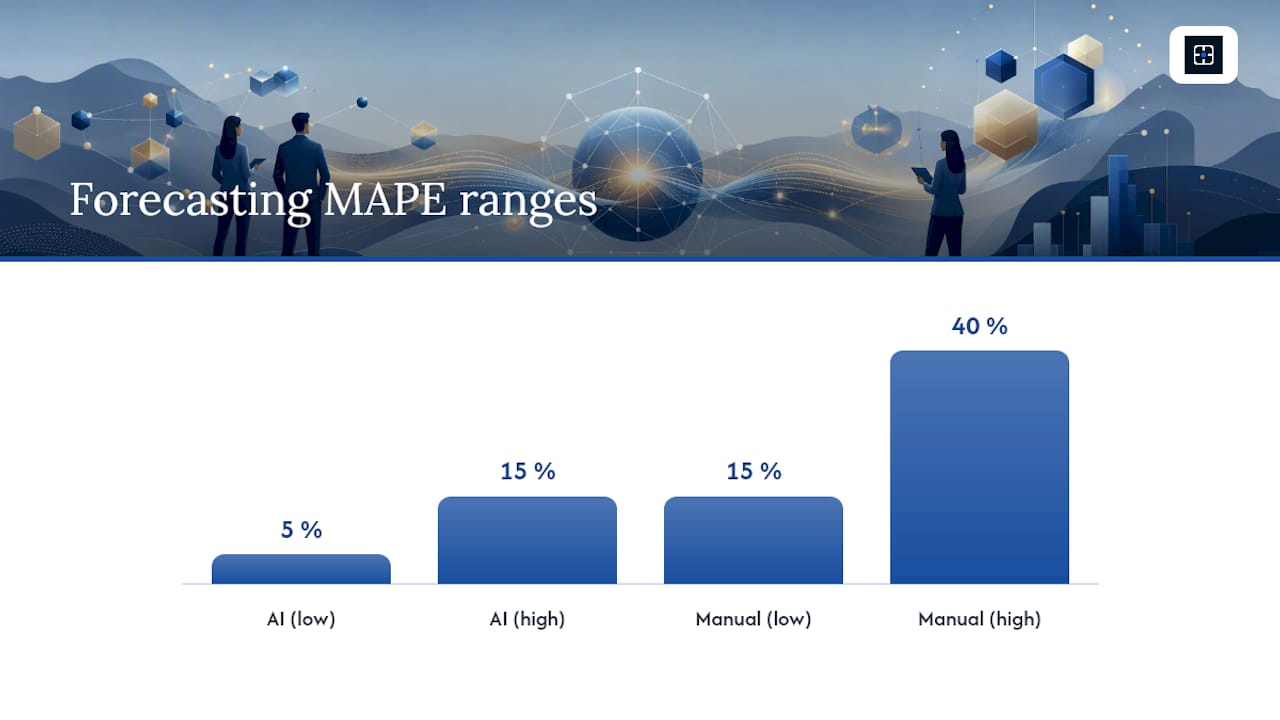
Industry data on well-configured AI forecasting systems suggests a meaningful gap against manual methods. One technical breakdown puts traditional forecasting error in the 15 to 40% range on MAPE (mean absolute percentage error), against 5 to 15% for well-configured AI systems on shorter horizons. The range is wide because “well-configured” is doing a lot of work in that sentence. A model fed twelve months of clean, consistent stage history behaves nothing like one fed a CRM full of stalled deals and undefined close dates.
The operational shift is often the most underrated part. Teams running this well report shorter pipeline reviews, because half the meeting used to be spent arguing about whose number was more credible. When the number is calculated the same way every time, that argument disappears and the meeting turns into what it should have been: a risk review.
Pro Tip: Don’t roll AI forecasting out team-wide on day one. Pick one segment (enterprise or mid-market, whichever has cleaner stage discipline) and prove the model against a full quarter before expanding.
How much clean data do you actually need first?
This is where most AI forecasting projects quietly fail, and it’s rarely the model’s fault. It’s the data.
You don’t need perfect data. You need consistent data. A model that sees a stage called “Proposal Sent” behave three different ways depending on which rep updated it will learn nothing useful, because there’s nothing consistent to learn. Industry guidance is blunt about this: data quality is the single most common reason AI forecasting deployments fail, ahead of model choice, ahead of integration complexity, ahead of everything else on the checklist.

There’s no single magic number for how much history you need, but as a practical baseline: fewer than six months of consistent stage history gives a model almost nothing to learn a pattern from. More history helps, but only if it’s the same pattern throughout. A CRM that changed its stage names eighteen months ago effectively has eighteen months of history, not three years.
Four fields matter more than the rest combined:
- Stage-change timestamps. Not just the current stage, the full history of when a deal moved and how long it sat.
- Activity logs. Calls, emails, meetings booked. This is the leading indicator that a deal is alive or gone quiet.
- Decision-maker contacts. A deal with no identified economic buyer behaves very differently to one that has one, and the model needs to see that distinction.
- Close dates. Specifically, how often they’ve moved, and by how much. A close date pushed four times is a different deal to one pushed once.
If your data isn’t there yet, the fixes are faster than most RevOps teams assume. Bulk enrichment tools can backfill missing contact and firmographic fields in days, not months. A stage-definition audit, walking every rep through what each stage actually means, usually surfaces the worst inconsistencies in a single working session. Timestamp clean-up is the least glamorous fix and the most necessary: if stage history was never tracked properly, no model can reconstruct it after the fact.
Data quality, not model sophistication, is the most common reason a deployment underdelivers, according to the same industry analysis cited above. That’s worth sitting with before you sign anything.
How do AI forecasts turn into numbers you can act on?
The calculation itself is simple to describe, even if the mechanics behind it aren’t. Every open deal gets a probability score. That score, multiplied by deal value, becomes its expected revenue contribution. Add every deal’s expected revenue together and you have your forecast. The interesting part isn’t the arithmetic. It’s what happens next.
- Aggregation should update continuously, not on a fixed schedule. A static rule set reviewed once a quarter is barely different from stage-weighting. A model that recalculates when a deal’s activity changes is a genuinely different tool.
- Explainability matters more than raw accuracy. A forecast you can’t explain to your CFO isn’t a forecast, it’s a black box with a number attached. Every score should trace back to something visible in Salesforce: an activity gap, a slipped close date, a missing contact.
- Human ownership doesn’t disappear. The model surfaces risk. A person still decides what goes into the number presented to the board. That’s not a compromise, it’s the point.
- Shadow mode is how you build trust before you rely on it. Run the model alongside your existing manual forecast for a full cycle before it replaces anything. Compare the two, don’t switch blindly.
This is the practical difference between a deterministic scoring approach and the probabilistic black-box models most vendors ship. Most enterprise forecasting tools will give you a number and ask you to trust the underlying scoring, sometimes literally described as a confidence percentage with no visible reasoning attached. A deterministic model produces the same score from the same inputs, every time, and every input traces back to a Salesforce field you can pull up and check. That’s a different conversation with your board than “the model says 78%.”
Governance in practice means someone owns overrides, and every override gets logged with a reason. If a rep insists a deal is stronger than the model says, that’s a legitimate conversation to have, not a fight to shut down. What matters is that the override is visible and attributable, not buried in a spreadsheet nobody checks again.

What’s the rollout path from data audit to live forecasts?
Skipping straight to “turn the model on” is how most AI forecasting projects earn a bad reputation inside six months. A phased rollout takes longer up front and saves you the credibility hit later.
- Audit and remediate your data first. Pull stage-change history, activity logs, and close-date movement for the last four quarters. Fix the worst inconsistencies (stage-definition drift is the usual culprit) before you let any model near the data.
- Run shadow mode for one full reporting cycle. The model generates a forecast, your team generates theirs the old way, and you compare the two without letting the model influence what gets reported to the board yet. This is the step teams skip, and it’s the one that builds the trust you need for step three.
- Use disagreements as coaching material, not verdicts. When the model and a rep disagree on a deal, that’s the most valuable five minutes in your pipeline review. Don’t assume the model is right. Ask what it’s seeing that the rep isn’t, and vice versa.
- Operationalise with a retraining cadence and closed-loop feedback. Once the model has proven itself across a cycle, set a schedule for retraining as new closed-won and closed-lost data comes in, and set an accuracy service level you’ll hold the system to going forward.
Practitioner guidance on rollout sequencing backs this order specifically: fix the data, shadow it, coach from the gaps, then operationalise. Reversing the order, particularly skipping shadow mode, is the most common reason teams abandon AI forecasting after one bad quarter and blame the model for a data problem.
Pro Tip: Keep a simple log of every disagreement between the model and your reps during shadow mode. After one quarter, you’ll have a clear pattern of who over-forecasts, who under-forecasts, and where the model itself needs recalibrating. That log is worth more than any dashboard.
Realistically, expect the shadow phase to run a full quarter minimum, and expect two to three quarters before the whole team trusts the number enough to stop double-checking it manually. That’s not a failure of the technology. It’s how long it takes a sceptical sales floor to believe a new number is real.
How do you know if the forecast is actually working?
Accuracy without validation is just a confident-sounding guess. Before you credit or blame the model for a good or bad quarter, you need a way to measure it properly.
The core metrics worth tracking:
- MAPE or WAPE (weighted absolute percentage error) measures how far off your forecast landed, as a percentage. WAPE weights by deal size, which matters more once a handful of large deals can swing the whole number.
- Calibration checks whether deals scored at 70% actually close around 70% of the time, not 40% or 95%. A model that’s consistently overconfident is arguably more dangerous than one that’s just imprecise.
- Bias tracks whether the model consistently forecasts high or low over time, a pattern raw accuracy figures can hide.
- FVA (forecast value added) compares your model’s accuracy against a naive baseline, like “assume next quarter equals last quarter.” If your model can’t beat that, it isn’t earning its complexity.
Set your baseline before you get excited about the model’s numbers. A seasonal naive forecast, last quarter’s actuals adjusted for known seasonality, is the honest comparison point. Practitioner guidance recommends walk-forward validation as the gold standard here: train on one period, test on the next, roll forward, rather than testing on data the model has already effectively seen.
Watch for three traps specifically. Data leakage, where information from after the forecast date accidentally informs the score, makes a model look far better than it will perform live. Structural changes, a new pricing model, a reorganised sales territory, a change in stage definitions, can silently invalidate a model trained on the old pattern. And small-sample noise, common in newer sales teams or narrow verticals, can make a handful of lucky or unlucky deals look like a trend.
One documented data point worth anchoring to: a hybrid forecasting model tested against traditional methods in an FMCG case study achieved a 35.9% reduction in mean squared error and a 21.4% decrease in MAPE. That’s a specific, sourced result, not a marketing claim, and it illustrates the ceiling that’s genuinely achievable with the right inputs and validation discipline. It also shows the gap between a well-validated model and one that’s just been switched on and trusted.
How does CommitControl fit into this?
Everything above describes what good AI sales forecasting requires: clean data, continuous updates, explainable scores, and governance that a board will actually accept. CommitControl was built around that last requirement specifically, because most forecasting tools treat explainability as an afterthought.
The deterministic model behind CommitControl means the same inputs always produce produces the same score. No probability drift, no “the model recalculated overnight and nobody knows why.” Every signal that feeds a score traces directly back to a Salesforce field: a stage change, an activity gap, a close date movement. When a board member asks why a deal is scored the way it is, the answer is a specific, checkable fact, not a confidence interval.
That matters most during a sales leadership transition, when a new VP inherits a pipeline they didn’t build and needs to reset the forecast on evidence rather than inherited assumptions. Forecast reset strategies built on traceable scoring let a new leader defend a number in their first board meeting, not their fourth.
For teams weighing the cost of getting forecasting wrong, the Sales Forecast Miss ROI Calculator puts a figure against what a missed forecast actually costs, beyond the obvious embarrassment. And for teams handling EU customer data, CommitControl’s security and data residency posture is worth checking against your own compliance requirements before you commit to any vendor.
What a VP sales should actually expect from this
Don’t expect instant miracles. If a vendor promises 95% accuracy in month one, that’s a sign they haven’t looked at your data yet, not a sign their model is better than everyone else’s.
Follow the sequence: audit your data, run shadow mode, coach from the disagreements, then operationalise. Skipping any of those four steps is how forecasting projects earn a bad reputation internally. Prioritise explainability and data hygiene over headline accuracy claims. A model that’s 5% less accurate but fully traceable will survive a board meeting. One that’s more accurate but unexplainable won’t survive the first hard question.
Good, realistically, looks like this after two to three quarters: your pipeline reviews are shorter, your coaching conversations are targeted at real disagreements instead of gut feel, and nobody’s asking “where did this number come from” anymore, because the answer is already visible.
— Brian
Ready to see a forecast you can defend line by line?
If you’ve read this far, you’ve likely already tried a forecasting tool that promised accuracy and delivered a black box. Most enterprise platforms in this category ask you to trust a confidence score without showing the reasoning behind it, which works fine until a board member asks a pointed question you can’t answer. CommitControl takes the opposite approach: deterministic scoring means the same Salesforce inputs always produce the same result, and every signal behind a score is traceable back to a field you can check yourself.
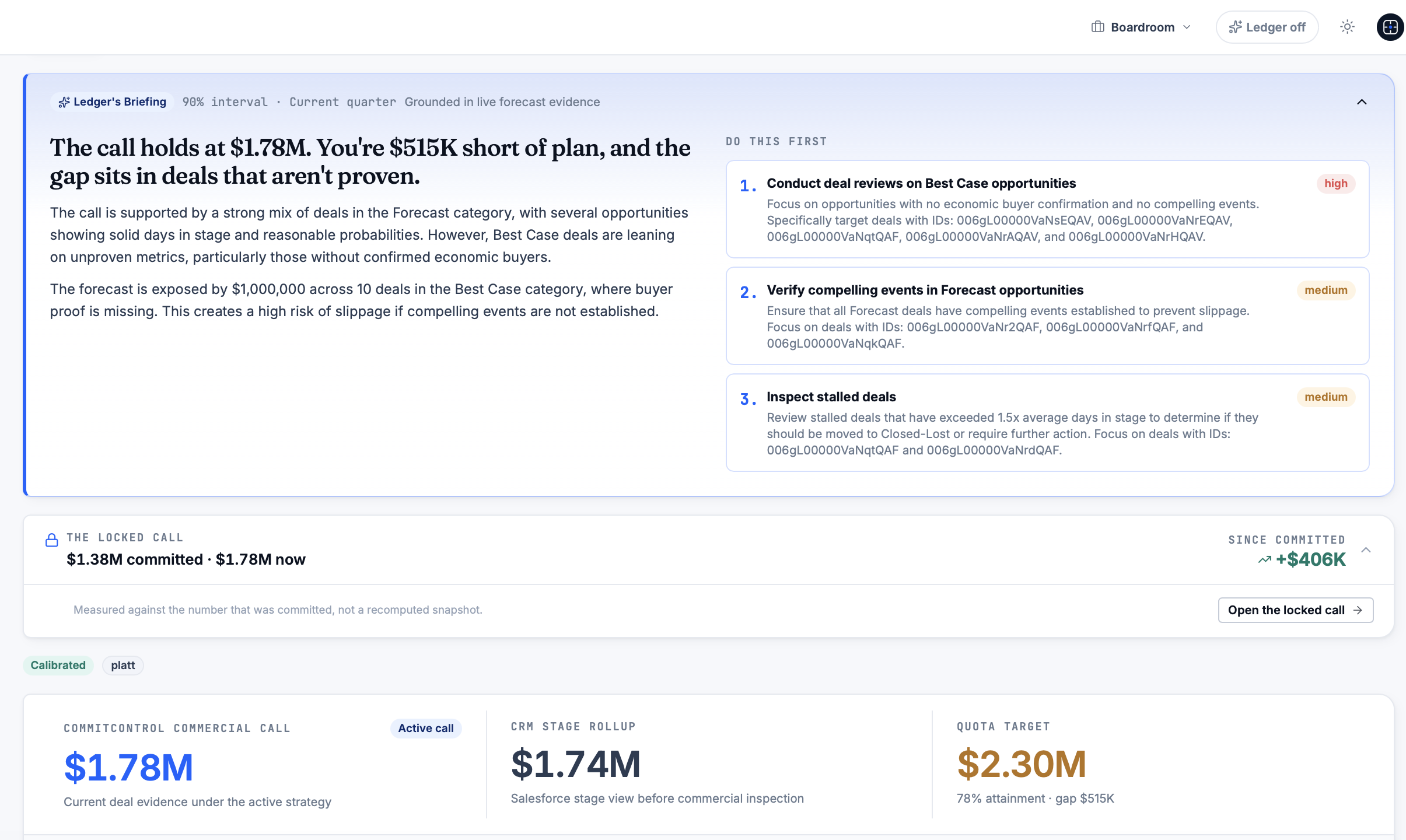
There’s no rep workflow to relearn. The platform reads directly from the Salesforce data you already have, and pricing is structured by organizational scope, including the whole team rather than per seat. If you want to see what your own forecast miss is actually costing you, the ROI calculator turns that into a specific figure in a few minutes. If you’re further along and ready to see the scoring against your own pipeline, book a walkthrough of CommitControl and bring your last two quarters of forecast-versus-actual with you. That’s the fastest way to see whether a deterministic approach would have caught the misses your team already lived through.
Sources
- Improve forecasting with AI projections
- How Does AI Forecasting Work? A Technical Explanation
- Machine learning sales forecasting: practitioner’s guide 2026
FAQ
How do you build a 12-month sales forecast?
Combine at least six to twelve months of clean historical stage and close data with a documented baseline (seasonal naive works well), then layer in deal-level scoring rather than static stage-weighting. Revisit and retrain the model as each quarter closes rather than treating the forecast as a one-off annual exercise.
Which AI tool is best for sales forecasting?
It depends on whether you need probabilistic ranges or auditable, deterministic scores. Tools like HubSpot’s AI projections give ranged estimates useful for pipeline visibility, while CommitControl focuses on deterministic, Salesforce-traceable scoring built for board-level forecast defence.
Can AI replace sales reps?
No. AI sales forecasting replaces guesswork in how a number is calculated, not the relationship work reps do to move deals forward. The model surfaces risk and inconsistency; a human still owns the final commit decision and the customer relationship behind it.
What’s the most reliable method for forecasting sales?
There’s no single best method for every business. A hybrid approach combining deal-level probability scoring with a validated baseline (like seasonal naive) and walk-forward validation consistently outperforms single-method approaches like pure stage-weighting or rep-only estimates.
How much historical data do you need before switching to AI forecasting?
There’s no universal minimum, but consistency matters more than volume. A CRM with six to twelve months of stable, unchanged stage definitions gives a model more to learn from than three years of history riddled with process changes.
Recommended
Editorial content. All metrics are Salesforce-derived and reviewed for accuracy. Not a substitute for professional judgment.
See the same discipline applied to your pipeline.
CommitControl derives every figure from your own Salesforce data. Nothing is invented, and every number traces back to the record it came from. Connect Salesforce and the same view runs live on your data within 24 hours.
Evaluate CommitControl